


XMSD Black Fungus Soaking Guide: Time, Temperature and Yield
Aug 21, 2026

How long should you soak black fungus? Use the instruction for the exact product, and keep a room-temperature soak within two hours. Hong Kong's Centre for Food Safety gives that two-hour ceiling for dried mushrooms and says to refrigerate them when soaking will take longer. The endpoint is not a universal clock: the ear or strip should be evenly hydrated to your approved texture, without a hard dry centre, then drained by a repeatable method and moved promptly to cooking.
A useful starting point for a controlled trial may be much shorter than two hours. A 2025 peer-reviewed study on one hot-air-dried jelly-ear material found that a 20-minute soak at 40°C produced texture closest to its fresh control. The authors also warned that drying conditions change texture and water absorption, so that result is not a universal pack instruction. We use it as evidence that temperature and product history matter, not as permission to print 20 minutes on every recipe.
The short answer: Start with the supplier's item-specific direction. For your trial, record water temperature, start time, dry mass, product form, endpoint, drain time and drained mass. Do not let a room-temperature soak pass two hours; refrigerate if the approved process needs longer. Use boiling water where the applicable FDA dried-mushroom advice governs, and remember that rehydration is not a substitute for the required cooking step.
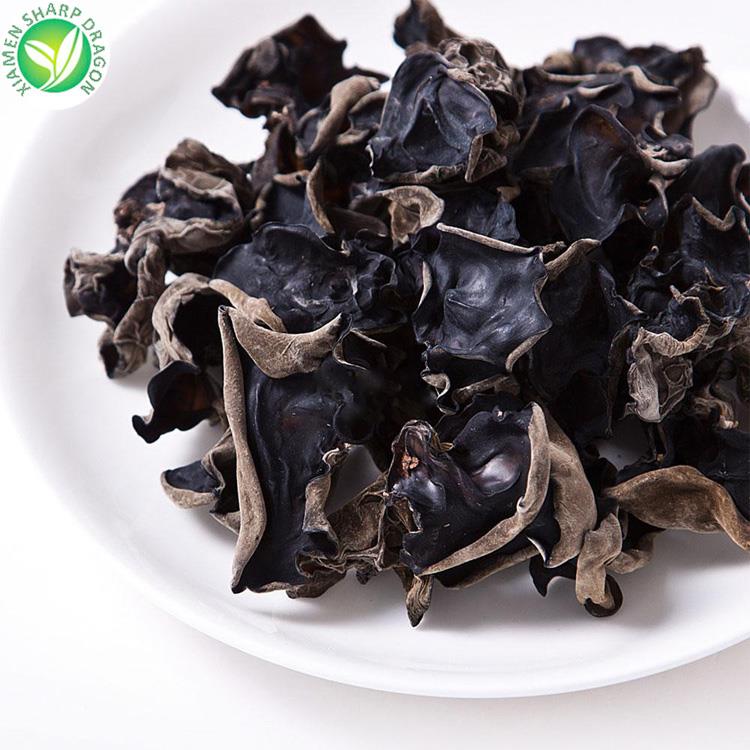
Separate a safety ceiling from a hydration target
The two-hour figure answers a food-safety question: how long room-temperature soaking should generally be allowed. It does not mean every black fungus needs two hours to hydrate, and it does not certify product quality at the two-hour mark. CFS advises washing dried mushrooms under clean running water, placing them in clean containers, avoiding excessive batch quantities, limiting room-temperature soaking to no more than two hours, or refrigerating, and then using the soaked product as soon as possible.
Your hydration target answers a different question: when has this item reached the texture, shape and mass needed for the next process? Thin strips, small pieces and whole thick ears do not hydrate at the same rate. Drying temperature, residual moisture, age, storage condition and physical damage also change water uptake. One clock copied from another pack can leave a thick piece dry in the fold while over-softening a thin cut.
Keep those decisions on separate lines in the work instruction. Line one states the permitted time and temperature boundary. Line two defines the product endpoint and the observation method. Line three states what happens after draining. If the endpoint is not reached before the approved room-temperature limit, the response is not to ignore the clock. Change the validated route, such as using an approved refrigerated soak, another water condition, a smaller batch or a product form that hydrates faster.
The question also begins after lot release. The separate XMSD guide to black fungus identity, hazards and release explains why soaking cannot repair the wrong species, a recalled lot, decomposition or failed incoming material. Start a hydration trial only with an identified commercial product that has passed your receiving decision.
Practical example: Your recipe says "soak for one hour," but the new supplier sends thin pre-cut strips. At 20 minutes, the strips are already flexible and have reached the approved drained ratio; at 60 minutes, they are softer and increase trim losses. Do not retain the old hour just because it is familiar. Confirm the food-safety route, run the item-specific checkpoints, approve the earlier measurable endpoint and revise the controlled instruction for that item code.

Choose water temperature as a controlled process variable
Water temperature changes hydration speed, texture and microbial conditions. It also changes what the process means. The US Food and Drug Administration advises that dried mushrooms not subject to recall should be reconstituted with boiling water to kill pathogens. That advice follows a 2020 Salmonella Stanley outbreak linked to imported dried wood ear. Recalled product should be discarded; hot water is not a recall remedy.
If you use hot or boiling water, record the product condition rather than the kettle setting alone. Adding dry fungus drops the water temperature, especially when the load is large. Whole ears can float, overlap or trap air. Define the product-to-water ratio, loading sequence, mixing method, vessel size and whether the measured time begins at addition or after recovery. Without those details, two operators can both write "20 minutes" while running different processes.
The 2025 texture study tested water from 20°C to 100°C and times from 10 to 70 minutes. Its hot-air-dried sample recovered texture closest to the fresh control at 40°C for 20 minutes. That is a useful trial point for comparable development work, but the study's own boundary is essential: other drying methods and temperatures alter texture and water absorption. Your supplied ear, cut or strip needs its own result.
Cold water can slow texture change and give an operation a wider handling window, but refrigeration is a control condition, not a licence for an undefined overnight soak. State the refrigerator set point, maximum duration, covered-container rule, labelling and next-step time. If no item-specific refrigerated instruction has been approved, do not invent one during a busy shift. The safest schedule is the one your facility can actually time, identify and move into the defined cook.
Do not transfer a temperature result between product forms without testing. A thin black fungus strip exposes more surface area than a folded whole ear. A compact dry ear may open gradually, while a broken piece may take up water rapidly. If an order changes cut, grade, drying process or supplier, treat water temperature and time as change-control items and repeat the relevant checkpoints.

Use checkpoints instead of guessing from appearance
Build a simple hydration curve for the exact item. We normally begin by weighing a representative dry sample, documenting piece dimensions and adding a defined mass of water in a clean vessel. Remove representative pieces at planned checkpoints such as 10, 20, 30, 45, 60, 90 and 120 minutes when that range fits the approved route. Drain each checkpoint by the same method before weighing and evaluating texture. These are experimental observation points, not a universal recommendation to soak for every listed time.
Use more than appearance. Open several whole ears and feel the thickest fold. Look for a hard or brittle centre, uneven expansion, excess tearing and loss of elastic bite. Measure drained mass after a fixed colander time rather than weighing pieces with an uncontrolled film of water. If the application uses strips, test the actual strip; if it uses whole ears, do not approve it from the fastest small fragments in the bowl.
Calculate drained rehydration ratio as drained hydrated mass divided by dry mass. For example, 1.00 kg dry becoming 7.00 kg after the fixed drain gives a ratio of 7.00 kg/kg. Report both the ratio and drain protocol. A result of 7.00 after two minutes in a wide colander is not directly comparable with 7.40 after a short hand drain. Free surface water can look like ingredient yield until it enters the sauce or leaves the pack.
Set acceptance limits only after repeated trials. A practical record includes lot, dry moisture or supplier specification, form, water temperature at start and during the soak, dry-to-water ratio, checkpoint time, drain time, drained ratio, texture score, trim loss and cook result. The approved time may be a range when the measurable endpoint remains stable, but the range must still sit inside the relevant safety boundary.
Practical example: Three trial lots reach 6.8, 7.1 and 6.9 kg/kg after the same 30-minute condition and five-minute drain. The texture panel accepts all three. A fourth lot reaches only 5.9 kg/kg and retains hard folds. Hold the fourth result for investigation; check piece thickness, dry condition and water-temperature history rather than extending the production soak without authorization. The evidence points to a lot or process difference, not a reason to erase the time rule.

Plan water, vessel and batch capacity before production
Black fungus expands, so a container that looks generous for the dry product can become overcrowded. Crowding creates uneven contact, folded dry centres and inconsistent draining. Define the dry load and minimum water volume for each vessel, leave room for expansion and use a method that keeps pieces in contact with the water. Do not solve floating or crowding with an unclean weight or a container that cannot be properly covered and sanitized.
Capacity should be based on the slowest controlled step. A kitchen may be able to fill four soak bins at once but cook only one drained bin every 25 minutes. Starting all four together creates waiting time after hydration. Stagger the starts so each lot moves from its approved endpoint into cooking, or use smaller identified batches. "Use promptly" becomes operational only when the schedule assigns a vessel, start time, drain time and cook slot.
Keep each lot identifiable. Label the bin with item, supplier lot, dry mass, water condition, start time, target check and operator. If two lots share a sink or drain area, protect them from mixing. When a result fails, traceability lets you hold the affected scope instead of discarding every prepared batch or, worse, serving material whose history cannot be reconstructed.
The detailed process after soaking belongs to the XMSD guide on cooking and safe service of black fungus. This soaking page ends its main clock at the defined drained endpoint; it does not claim that a soft, expanded fungus is ready to eat. The following cooking, cooling or hot-holding controls remain part of the complete recipe.

Worked example: turn a soak trial into a production schedule
Assume a hypothetical foodservice line needs 150 kg of drained hydrated black fungus for one shift. Its approved trial uses 20 kg dry product per vessel and produces 6.80 kg drained product per dry kilogram after the chosen condition and fixed drain. One vessel therefore gives 20 kg × 6.80 = 136.0 kg drained. That is not enough for the shift, and starting two full vessels would produce a large avoidable surplus.
Calculate the dry requirement from the measured ratio: 150 kg ÷ 6.80 kg/kg = 22.06 kg dry. Add a 3% planning allowance for approved trim and normal variation: 22.06 kg ÷ 0.97 = 22.74 kg dry. If the first vessel is capped at 20.00 kg, the second needs 2.74 kg dry rather than another 20 kg. At USD 6.40 per dry kilogram, planned ingredient cost is 22.74 × USD 6.40 = USD 145.54, or about USD 0.970 per drained kilogram.
The arithmetic only works when both batches use the validated loading and drain basis. A 2.74 kg top-up batch in a different vessel may hydrate faster than a 20 kg load. Keep the approved water-to-product ratio and mixing geometry, or run the smaller vessel as a documented variant. Schedule its start so the smaller batch does not wait at room temperature while the main load occupies the cooker.
Now test reality. Weigh the actual drained output, approved trim and cooked output. If the shift receives only 143 kg drained from 22.74 kg dry, the effective ratio is 143 ÷ 22.74 = 6.29 kg/kg, below the trial basis. Investigate water temperature, crowding, dry-lot variation and drain method. Do not hide the loss by shortening the drain or serving more surface water. Update planning only after a repeatable corrected result.
Calculation rule: Keep dry mass, drained hydrated mass and usable cooked mass as three separate bases. A nutrition figure or portion cost can change dramatically when a dry-basis value is accidentally applied to hydrated product. The XMSD article on black fungus evidence and yield explains that basis distinction in detail.

Know when to reject a soaked batch
CFS advises discarding soaked mushrooms when slime or abnormal smell appears. Those are clear rejection signals, but their absence does not prove microbiological safety. Also reject or hold a batch when the start time is unknown, room-temperature history exceeded the approved limit, refrigeration history is missing, lot identity was lost, the container or water was not acceptable, or the material contacted an uncontrolled surface.
Do not reset an exceeded time history by changing the water, refrigerating late or cooking the product. A process deviation needs the disposition defined by your food-safety program. If the lot is recalled, isolate and discard it according to the notice. FDA's boiling-water advice explicitly applies to dried mushrooms that have not been recalled; it does not turn recalled material into acceptable stock.
Quality failures also need a rule. Persistent hard folds, excessive fragmentation, weak or mushy texture, abnormal colour, grit and inconsistent drained ratio can make the lot unsuitable for the planned dish even when no obvious spoilage signal appears. Record the failure against the item and lot, preserve a representative sample where your procedure allows, and ask whether the cause is product condition, preparation or both.
Practical example: An operator finds an unlabelled bin of flexible black fungus in the refrigerator. It smells normal, but no one can establish the dry lot, soak start, room-temperature duration or refrigeration time. Do not assign a new label from the discovery time. Hold and dispose of it under the site's deviation rule, then repair the identification step so the next bin carries its history from dry issue through cooking.
Dried or frozen: choose the workload you can control
Dried black fungus offers compact ambient storage before opening and a high mass gain during hydration. It also places rinsing, timed soaking, vessel capacity, drainage and hydrated-lot identification inside your operation. Review the relevant dried black fungus product direction, then request the exact form, size, pack, preparation instruction and drained-yield evidence needed for your application.
Frozen product removes the dry rehydration step and can simplify same-day scheduling, but it creates other controls: frozen storage, pack integrity, thaw or direct-cook instruction, released water and cooked yield. The frozen black fungus option is worth testing when soak capacity, labour, drain space or yield variation constrains the dried route.
Compare both on usable cooked output. For dried product, include dry cost, hydration labour, water, vessel occupation, trim and cooked yield. For frozen product, include delivered frozen cost, cold storage, thaw or direct-cook labour, released water and cooked yield. Do not assume the lower invoice cost per kilogram is the lower cost per portion. Equally, do not change product form solely to avoid writing a disciplined soak instruction.
When you request samples, run them at the intended production load. A 100 g bench sample may hydrate evenly while a 20 kg vessel crowds and cools. Ask the supplier for the current item instruction and link every trial to item code, lot and pack. If the product changes, the old timing record remains evidence for the old item, not automatic approval for the new one.

What to put in the final black fungus soaking specification
Name the commercial species or accepted product identity, form, cut or size range, dry condition, item code and intended application. Attach the supplier's current preparation instruction. State the rinse, water condition, dry-to-water ratio, maximum load, vessel, agitation or submersion method, target time or endpoint range, maximum permitted time, drain method and next cooking step. These fields turn "soak until soft" into an instruction that two shifts can reproduce.
Define records and deviations. Record lot, start, temperature, checkpoint, drain and release. Name the person who can approve a product or process change. State what happens after a missed clock, temperature excursion, lost label, abnormal smell, slime, hard-centre failure or yield result outside the accepted range. Staff should not have to invent a disposition with a full cooker waiting.
Finally, connect hydration to commercial planning. Ask for representative samples, measured dry and drained masses, photos of the supplied form, packing options and destination requirements. We can compare sample behaviour only when the trial states its conditions. "Expands well" is not a specification; a drained ratio tied to a water condition, time, load and drain method is decision-useful evidence.
XMSD sourcing note: Share your required form, dry batch size, target hydrated texture, cooking route, packing and destination. We can review a dried or frozen black fungus sample plan and the measurements needed for a useful comparison.
Final Thoughts from XMSD
There is no responsible universal answer such as "always soak black fungus for three hours." Keep room-temperature soaking within the two-hour CFS ceiling, use refrigeration when an approved longer process requires it, and follow applicable boiling-water guidance. Then determine the actual endpoint for your exact ear, piece or strip through timed, temperature-controlled trials with a fixed drain.
The best time is the earliest approved checkpoint that produces even hydration, target texture and repeatable drained yield while preserving the complete safety route. Record the item and lot, match starts to cooking capacity, reject unknown or exceeded histories and retest after a material product change. That approach gives you a usable production specification instead of a copied clock.
References
- Hong Kong Centre for Food Safety: Soaking Mushrooms and Food Safety
- US FDA: Salmonella Stanley Outbreak Linked to Wood Ear Mushrooms
- Discover Food: Texture and Optimized Rehydration of Hot-Air-Dried Jelly Ear Mushrooms
- Frontiers in Microbiology: Pathogen Growth During Dried Mushroom Rehydration and Storage
- Food Control: Processing Conditions and Pesticide Residues in Auricularia auricula-judae
- XMSD operational experience in frozen-food preparation, quality control, packaging and B2B application planning.