


Frozen Brussels Sprouts: How to Cook Them Crisp and Tender
Aug 21, 2026

You can roast frozen Brussels sprouts straight from the freezer when the package directions allow it. Spread loose, similarly sized pieces in one layer so moisture can escape. Check the largest center as well as the browned surface. Whole sprouts keep their shape for serving. Halves give the hot tray more cut surface to brown.
For a browned, tender result, use the method and endpoint specified for your pack, then test the load your tray or basket can handle. If the outside darkens while the largest center is still firm, use a more even size next time or cook separate size groups. If the pan stays wet, check the surface ice and try a smaller load.
The short answer: Choose halved, fairly uniform sprouts for fast browning and repeatable service. Choose whole sprouts when appearance matters more than speed, then allow more time for the center. Do not crowd a dry-heat appliance, do not assume blanching means ready to eat, and validate the method with the actual pack, piece size and batch weight you will use.

Start with the Product, Not a Fixed Timer
A cooking time has meaning only after you name the product form and equipment. A 20 mm sprout and a 40 mm sprout do not share the same heat path. A halved sprout exposes the center and releases moisture differently from a whole one. A 300 g layer in a wide basket does not behave like 1 kg piled into the same basket. We therefore begin by reading the pack, checking whether the pieces separate while frozen, measuring representative diameters and deciding what the served result must be.
When the instructions permit direct cooking, take a loose, evenly sized portion from the freezer and spread it out promptly. A separate thaw can release liquid, so plan a drain step if the recipe calls for thawing before halving. See the guide to safe thawing and cooking from frozen when deciding which starting state to use.
Brush away loose ice before roasting a sound, free-flowing pack when its instructions allow. A wet carton, damaged seal or heavily fused pack is a reason to check the lot and its temperature history. At receiving, keep suspect packs identified and follow the hold procedure before they enter a cooking trial.
Practical example: You have two 500 g retail packs for the same oven. Pack A contains loose medium whole sprouts with light frost. Pack B contains mixed diameters and several ice-bound clusters. Spread each on a separate preheated tray at the same load. Pack A can go directly into the test. For Pack B, remove loose ice, separate what can be separated without thawing, and record the remaining clumped weight. If its largest centers are still firm when the small pieces are already dark, reject one-time timer adjustment as the solution; the size and free-flowing specification needs correction.
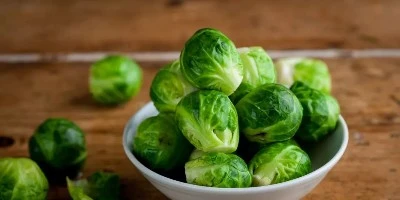
Whole, Halved and Size-Graded Sprouts Cook Differently
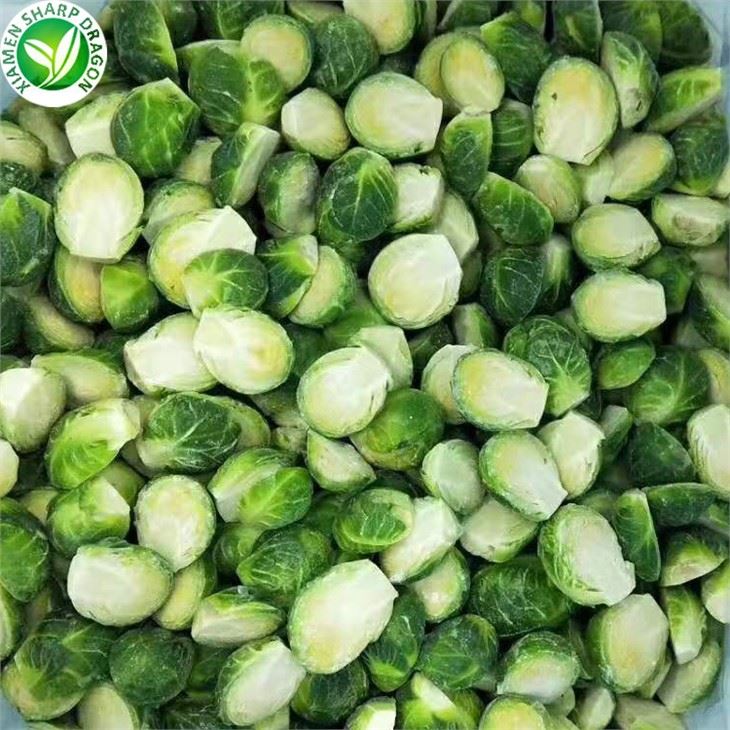
Whole and halved Brussels sprouts solve different kitchen problems. Whole pieces keep the familiar compact-bud appearance and tolerate movement in soups, braises and steam service. Their center is protected, but the heat must travel farther, so a mixed-size lot creates a wide finish window. Halves shorten that path and create a flat face for tray or pan contact. They are our first choice when you need faster browning, more seasoning contact and a narrower service window.
The current Codex CXS 320-2015 annex gives a guide for size-graded whole sprouts: very small 12–22 mm, small over 22–26 mm, medium over 26–36 mm and large over 36 mm. It gives measurement with a square-hole sieve or caliper in the frozen condition. These are reference size names. Record the actual size band and method in your specification before linking it to a cooking trial.
| Product form | Cooking behavior | Best starting application |
|---|---|---|
| Small, whole, narrow band | Heats more evenly than mixed whole sizes and keeps a compact shape | Steam service, side dishes, soups and braises |
| Medium or large, whole | Needs more center-heating time; exterior may darken first under dry heat | Applications where whole appearance is the priority |
| Halved, reasonably uniform | More cut-surface browning, faster heat penetration and easier seasoning contact | Roasting, air frying, sautéing and ready-meal finishing |
Loose leaves are not merely a cosmetic issue. A few detached leaves can become crisp accents under dry heat, but they cook much faster than intact buds. A high loose-leaf load produces dark fragments before the thick pieces finish, lowers usable plated yield and makes seasoning distribution uneven. For soup or sauce, some fragments may be acceptable; for a clean whole-sprout side, they may be a reject. Put the allowed loose-leaf level and its measurement basis into the acceptance sheet instead of relying on a photograph of the unopened bag.
Match the Method to the Endpoint You Actually Need
Oven roasting: strongest option for a browned, dry surface
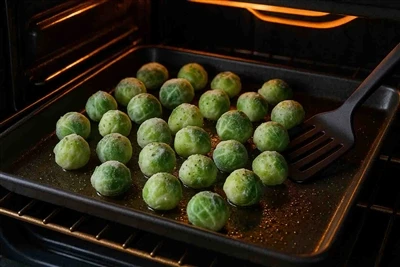
If the pack supports oven roasting, follow its directions and spread the sprouts in a single layer. Leave space around the pieces and put an exposed cut face against the tray where practical. When the tray is steaming and the sprouts are still pale, test a smaller load before extending the cook for the whole tray.
Load controls the result more than small timer changes. A crowded tray creates a humid layer, slows browning and may force you to extend the cook until the outer leaves become too dark. If the oven must handle a larger mass, use more tray area or stage the batches. Do not solve crowding by raising the temperature indefinitely. The outside can scorch while a large whole center remains cold or firm.
For an uncut tray, choose loose, evenly sized whole sprouts and roast from frozen if the directions support it. For a flatter browned face, buy halves or use the thaw-and-drain step in a recipe designed for that product before cutting. Try balsamic or lemon at service if you want acidity without adding more liquid during the browning stage.
When comparing two trays, note whether water collects in the middle or at the edges. Move to the next trial with a defined tray area and mass so the cook can reproduce the better result.
Air frying: fast moisture removal, limited by basket area
Use the air fryer when the product instructions support that method and the basket holds the portion in a shallow layer. Follow any turning directions. Test the largest pieces at the required endpoint before serving. A deeper basket load reduces the surface exposed to moving air and can leave some pieces softer than others.
Sautéing, steaming and microwaving: choose tenderness before browning
A pan method works best in two stages for whole frozen sprouts: use a small amount of water and a lid to heat the center, drain or evaporate the remaining water, then uncover and brown in oil. Halves can move into the dry stage sooner. Steaming and microwaving are better when speed, moisture retention and a tender green side matter more than roasted color. Follow the pack's weight, vessel, wattage, standing time and endpoint instead of transferring a number from another SKU.
A Birds Eye recipe for its 10.8 oz Steamfresh pack illustrates a thaw-first approach. The recipe briefly microwaves to thaw, drains and halves the sprouts, then roasts them in one layer at 450°F for 18–22 minutes before the finishing step. Use those settings only with that recipe and product. A pack intended to cook in its steam bag can have different preparation and handling directions.
Judge doneness with more than color. The largest center should be hot and pierce with light resistance rather than feel icy or woody. The outer leaves should be dry enough for the intended method, the aroma should be clean rather than sulfur-heavy from prolonged wet heat, and the cut face should show the target browning without char covering most of the surface. In commercial service, define the result after the planned hold, not only at the moment the tray leaves the oven.
Safety note: Frozen and partially heat-treated do not automatically mean ready to eat. FDA guidance for ready-to-cook foods says freezing may not kill harmful bacteria and partial factory cooking may not be a complete kill step. Follow the pack's cooking directions, including standing time and center checks. For a B2B item, state clearly whether it is ready to cook, ready to heat or ready to eat, and validate the intended use against that status.
Blanching Protects Frozen Quality; It Does Not Define Ready-to-Eat Status
The current Codex annex describes quick-frozen whole Brussels sprouts prepared from trimmed, sorted, washed buds blanched for color and flavor stability. Treat that product definition as a quality reference. Check the exact pack's intended use and cooking directions before serving the product.
Blanching also explains part of the texture difference from fresh. Heat softens tissue, and freezing introduces further structural change. A dry-heat method can remove surface water and brown exposed leaves, but it cannot restore raw cellular firmness. The practical goal is therefore controlled tenderness with a dry, browned exterior. If a menu promise requires the hard, deeply layered crunch of fresh restaurant-style sprouts, run a side-by-side trial before substituting frozen product.
Process history changes performance. Under-blanching can leave weaker color or flavor stability over frozen storage; excessive blanching can shorten the later cooking window and produce a soft center before browning develops. Good drainage before freezing supports free flow and reduces excess surface ice. Our overview of frozen vegetable processing and quality control explains how blanching, cooling, drainage, freezing and inspection interact. For Brussels sprouts, request the declared preparation state and prove the result with a cooking trial rather than inferring it from the word IQF.

Scale the Method with a Batch Trial, Not Simple Multiplication
Five kilograms do not cook like ten household bags placed together. Scale changes tray area per kilogram, oven recovery, steam load, turn frequency and the delay between cooking and service. For restaurant chains, central kitchens and catering lines, we recommend a controlled trial in the actual equipment. The foodservice and catering application should determine the test weight, pan depth, portion size and hold period.
- Record the SKU, whole or halved form, diameter band, frozen starting condition, loose-leaf mass and visible surface ice.
- Fix the equipment, preheat setting, tray or basket dimensions, product weight per tray and oil or seasoning addition.
- Record oven recovery, turn point and total time. Check several large centers rather than the easiest small pieces.
- Weigh the cooked output, then separate burned leaves, undercooked centers and pieces outside the visual target.
- Hold the accepted output under the real service condition for 10, 20 or 30 minutes, whichever matches the menu, and repeat the texture and free-liquid check.
- Repeat on another production lot before locking the instruction. A single attractive tray does not prove batch consistency.
Holding is often the hidden failure point. Steam keeps moving from the hot center to the surface after cooking. A deep covered pan traps that moisture and softens browned leaves. If service requires a hold, use a shallow layer, avoid an airtight cover when the food-safety plan permits venting, and keep the hold as short as practical. A method that gives excellent color at minute zero but limp, wet pieces at minute 20 is not the right commercial method.
Practical example: A hypothetical central kitchen tests medium halved sprouts in a convection oven. Trial A loads 1.0 kg on each of five full trays. Trial B loads about 1.67 kg on each of three trays. Both use the same oven set point and 5.0 kg frozen input. Trial B looks efficient on paper, but if recovery is slower, free liquid remains on the trays and 20-minute holding turns the lower layer soft, do not merely add five more minutes. Reduce the load per tray, retest the endpoint and compare usable yield after holding.

Build a Brussels Sprouts Specification Around Cooking Performance
A product name alone cannot control the result. Start with form: whole, halved or another agreed presentation. Add the diameter band and measurement method, because mixed sizes widen the finish window. Define free-flowing condition, clumps, loose leaves, broken pieces, poorly trimmed bases, yellowing, mechanical damage and foreign material. Then state the cooking method and endpoint used for approval. The live XMSD frozen Brussels sprouts range provides the product context; the approved order specification and trial sheet must carry the measurable acceptance details.
Use the Codex Brussels sprouts annex and the USDA grade standard to define the defects you will inspect, such as loose leaves, poor trimming or damage. For a tray-roasting program, also set an order-specific limit on the weight of clumps that cannot easily be separated while frozen. Record that separately from cooked texture and the requirements for safe preparation.
Do not approve only a frozen sample laid neatly on a plate. Cook it at the planned load. Record frozen weight, cooked drained weight, accepted weight after defects are removed, seasoning addition and hold loss. For retail, test the printed household instruction in the target appliance range. For foodservice, test the opened inner pack as the kitchen will use it. A pack size that leaves a partially used bag open through several services raises exposure to frost and handling; a pack that is too small increases packaging and labor. Match the inner unit to shift consumption, then review seal integrity, carton protection and pallet handling through the frozen-food packaging options.
Worked example: Assume a 5.0 kg trial lot costs USD 2.40 per frozen kilogram, so frozen input cost is USD 12.00. Trial A uses five trays and leaves 4.10 kg that still meets the color, tenderness and surface-dryness target after a 20-minute hold. Usable yield is 4.10 ÷ 5.00 × 100 = 82%. Usable product cost is USD 12.00 ÷ 4.10 kg = USD 2.93 per usable kilogram. Trial B crowds the same 5.0 kg onto three trays and leaves 3.55 kg acceptable after soft, wet and overly dark pieces are removed. Its usable yield is 71%, and usable product cost becomes USD 3.38 per kilogram. The hypothetical USD 0.45 difference shows why frozen purchase price alone cannot select the method or SKU. Replace every input with your quoted price, actual tray plan and agreed acceptance result.
Arrival inspection completes the loop. Check frozen condition, bag seals, carton damage, unusual ice, clumping, broken pieces and label status before the first production test. If the lot differs from the approved sample, keep the comparison evidence: photographs, weights, measured size distribution, cooking sheet and retained sample where the quality plan allows it. That evidence separates a product-form problem from a cold-chain or kitchen-load problem and gives both sides something measurable to resolve.

A Reliable Decision in One Sentence
For a browned result, choose uniform halves and follow the product's preparation instructions. Cook from frozen only when those directions allow it. Give steam room to escape, check the largest centers and assess texture after the actual service hold. If you want to serve whole sprouts, check the center and adjust the next trial by sorting sizes or changing the tray load.
XMSD sourcing note: Send us your target whole or halved form, size band, cooking equipment, batch load, pack format, destination and acceptance trial. We can review the requirement and prepare a product discussion against the agreed application.