


Frozen Apple Slices: Applications, Handling and Usable Yield
Aug 21, 2026

Frozen apple slices work best in products where the fruit will be baked, cooked, blended or held in a sauce. Pies, tarts, turnovers, crumbles, fillings, compotes, apple sauce, beverage bases, chutneys and cooked savory accompaniments can all use them well. They are a weaker choice when you need the crisp bite and dry surface of a freshly cut apple.
The application is only the first decision. Variety and maturity influence sweetness, acidity and firmness; slice thickness changes heating and breakage; anti-browning treatment changes color and ingredient declaration; and the pack may contain plain fruit, sugar, syrup or another agreed medium. Freezing also changes apple tissue, so some liquid normally appears during thawing or heating. You can use the slices from frozen when the formula has been developed around that liquid and the added heat load. Thaw them under controlled chilled conditions when you need to measure drainage, standardize fruit weight or protect a moisture-sensitive filling.
The short answer: match the slice to the finished process, not to a recipe name. Start with firmness, thickness, peel condition, browning treatment, packing medium and free-liquid behavior, then approve the fruit in the real oven, kettle, blender or filling line.

Choose the Application Before You Choose the Slice
A visible pie layer and a smooth beverage base ask opposite things from the same fruit. The pie needs recognizable pieces after baking; the beverage needs predictable breakdown and low equipment stress. Sauce can accept softening that would be a defect in a tart. A savory chutney may welcome peel flecks and acidity, while a pale pastry filling may require a cleaner cut surface and tighter color control. That is why we start with the finished texture, the heat process and the way the fruit is dosed.
| Application | Useful slice behavior | Trial decision |
|---|---|---|
| Pie, tart, turnover | Visible pieces, controlled softening, balanced liquid | Check crust, filling set and slice identity after cooling |
| Industrial filling | Repeatable thickness, pumping tolerance, defined drained mass | Check breakage through mixing, transfer and deposit |
| Sauce or compote | Predictable breakdown and flavor release | Set chunky or smooth endpoint and final yield |
| Beverage base | Easy blending, manageable particle load, stable color | Check blender or mill load, separation and filtration |
| Savory sauce or chutney | Acidity, controlled pieces and compatibility with spices | Check flavor balance, piece size and hold texture |
The table is a starting map, not an acceptance specification. A slice that survives a short bake may break during a long kettle cook, and a fruit that looks firm immediately after heating may soften during chilled storage. Include the full process and hold period in the trial. If the filling is pumped, test the actual pump and deposit head. If the sauce is hot-filled, inspect the fruit again after the thermal process and cooling.
Slices are not automatically better than dice. When you need visible apple layers or a recognizable curved shape, slices earn their place. When you need even distribution in muffins, yogurt preparation or a narrow filling nozzle, a smaller format may be more reliable. You can compare the wider XMSD frozen fruit range only after deciding what shape the finished product must show.

Variety, Firmness and Thickness Control the Final Bite
Variety matters because apples do not share one balance of firmness, water, sweetness and acidity. Extension guidance identifies some cultivars as stronger baking choices and others as more suitable for sauce. That information helps you build a trial shortlist, but a variety name alone does not predict frozen performance. Maturity at processing, raw-fruit condition, cutting, pretreatment, freezing rate and storage history can move the result enough to change the application decision.
For a layered tart or open pastry, we would begin with a firm slice that still shows its contour after the full bake. For apple sauce, a softer cultivar can reduce the time needed to reach a smooth or chunky endpoint. A beverage processor may care more about acidity, clean flavor and mill behavior than intact shape. Record the cultivar or blend, crop information where relevant, maturity basis and sample result together; otherwise a successful test cannot be repeated with confidence.
Thickness affects heat transfer, portion weight and breakage. Thin pieces heat and soften quickly, but they can lose identity in a long cook. Thick pieces give a stronger bite, yet they may remain firmer than the surrounding filling or create an uneven deposit. Uniformity is as important as the nominal number. A lot described as 10 mm slices is not controlled if many pieces fall far above or below that target or if broken fragments dominate the bag.
The USDA frozen apple grades use color, flavor, size uniformity, defects and character as scored quality attributes. Those grades apply only when they are called into the contract, but the structure is useful for any approval plan: define what acceptable color and character mean, state the slice measurement method, and set defect categories that relate to the use. Core tissue, peel, damaged areas and broken pieces do not carry the same consequence in a dark spiced sauce as they do in a pale visible filling.
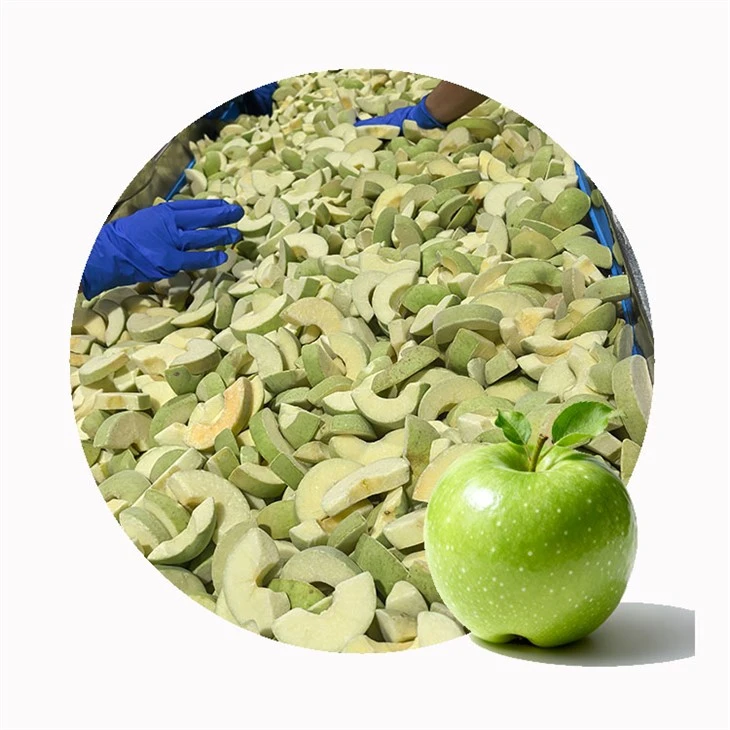
A live frozen green apple slice product reference shows one offered 1.5 cm machine-cut direction. Treat that as a specific product reference, not a universal apple standard. If your pastry or filler needs another thickness, send the target and test an offered sample rather than assuming that every cut is available.

Browning Treatment and Packing Medium Change the Formula
Once an apple is cut, oxygen can drive enzymatic browning at the exposed surface. Variety, air exposure and processing conditions change the rate, so one visual claim such as "natural color" is too vague for approval. Ascorbic acid, citric acid, blanching and combinations of treatments are used in apple processing. Published work also shows cultivar-specific responses, which is a good reason to judge the offered fruit and treatment together instead of copying a single laboratory condition into every purchase specification.
Ask for the exact ingredient statement and process description that apply to the offered lot. An anti-browning treatment can improve color while also affecting flavor, texture, label wording or suitability for a particular market. "Treated" and "untreated" are not complete specifications. Name the substance or blanching step, identify the declaration needed on your finished product, and compare color in the frozen, thawed and processed states.
Packing medium changes both recipe math and sensory balance. USDA Commercial Item Description A-A-20379 recognizes IQF fruit with fruit juice, sugar syrup, sugar pack, no packing medium or another specified medium. The National Center for Home Food Preservation similarly distinguishes syrup, sugar and dry packs by intended use. These documents are not a promise that every commercial format is available, but they show why "frozen apple slices" is not a complete item description.
Application rule: plain or dry-packed slices give you the most direct control over sugar and liquid in a formulated filling. Sugar-packed or syrup-packed fruit can suit products designed around that medium, but the added solids and liquid must enter the mass balance. Never compare their delivered price per kilogram as if all kilograms contain the same amount of apple.
If the package contains syrup, record both net mass and drained fruit mass under a stated method. If it is a sugar pack, measure how the pack behaves during thawing and whether the sugar is already included in the finished formula. If it is plain IQF fruit, still check loose frost and free liquid because the absence of a packing medium does not mean zero water release.
Free Liquid: Measure It Before You Adjust the Recipe
Freezing forms ice inside and between cells. After thawing, the tissue is normally softer than fresh apple and some liquid separates. Faster freezing can reduce large ice-crystal formation, but IQF does not make thawed fruit identical to fresh. The practical explanation in our IQF freezing guide is useful here: individual pieces improve portioning, while final texture still has to be tested in the intended process.
Do not label a sample "watery" without a method. We recommend weighing a representative frozen sample, thawing it under a defined chilled condition, draining it on the same screen for the same period without pressing, and recording fruit mass and collected liquid. State whether loose surface ice stays in the starting weight. The purpose is repeatability, not finding a number that makes one lot look better.
Decide what the formula does with the liquid. A sauce or compote may keep it because it carries soluble apple solids and contributes to the cooking base. A pie may retain part of it and adjust starch or pre-cooking. A pastry filling that must protect a crisp shell may use drained fruit weight. A beverage may recombine pulp and liquid but still needs a consistent total-solids and acid balance. Write the mass basis into the batch sheet: frozen gross weight, thawed total weight or drained fruit weight.
Clumping deserves a separate check. Pieces frozen together can dose unevenly, but a block is not proof of one cause. Pack compression, surface moisture and temperature variation can all contribute. Compare the bag condition with temperature evidence and the agreed free-flow expectation. For broader storage and arrival signals, use the frozen fruit storage and quality guide alongside the product specification.
Use From Frozen or Thaw First?
Use the slices from frozen when the recipe has been validated for their heat load and released liquid. This often suits cooked sauce, compote, crumble and a filling designed specifically for frozen fruit. Direct use limits handling and keeps the pieces firm during early mixing, but it can lengthen heat-up and release water later in the process. Increase thickener or bake time only after measuring the effect; an automatic correction can make the filling pasty or overcook the fruit.
Partially thaw when you need to separate clusters or fold pieces into a batter with limited mechanical damage. Fully thaw under controlled chilled conditions when the formula is based on drained mass, when a filling must have a defined free-liquid level, or when your trial needs a clear post-thaw texture result. Keep the liquid until the formulation decision is made. Draining first and asking questions later removes both water and soluble apple material without telling you how much.
The processing sequence matters. For a pie, test frozen fruit in the complete filling rather than warming bare slices and then judging them. For sauce, add the slices to the kettle with the defined liquid and cook to the selected piece-size endpoint. For beverage work, compare direct frozen blending with controlled thawing at the same fruit loading; watch equipment load, particle distribution, air incorporation and separation after the planned hold.
Practical example: suppose you are approving two hypothetical slice cuts for a baked filling. Run 10.0 kg of 8 mm slices and 10.0 kg of 15 mm slices through the same thaw basis, sauce formula, mixer, deposit weight, oven program and cooling period. Record drained mass, broken pieces after mixing, pieces visible in ten standard portions and free liquid after cooling. Choose the thinner cut if the thicker pieces remain too firm or obstruct deposit; choose the thicker cut if the 8 mm fruit loses visible identity. The result belongs to that filling process, not to every bakery.

Application Guidance for Bakery, Sauce, Beverage and Savory Products
Bakery and filling
For pie, tart and turnover filling, approve the fruit after the product has cooled. Hot starch can look stable and then relax; a slice can seem firm in the oven and soften during storage. Inspect bottom-crust condition, filling set, slice identity, sweetness-acidity balance and the percentage of broken pieces that remains visible. If the product is frozen again after assembly, add the finished-product freeze-thaw cycle to the test.
A continuous filling line adds mechanical requirements. Long curved slices can bridge a hopper or orient poorly at a deposit head. Smaller segments or dice distribute more evenly, but they change the consumer's visual impression. We would approve both formula performance and line handling. A bench-top pie can succeed while the same fruit fails during pumping or portioning.
Sauce, compote and beverage
Sauce and compote are forgiving because softening is part of the intended transformation. Choose the fruit by flavor, acidity, breakdown rate and final piece-size target. For a chunky compote, stop the cook while recognizable pieces remain. For smooth sauce, a softer material can reduce milling work, although skin and core residue still require control. Measure final kettle yield at the same endpoint rather than comparing cook time alone.
Slices can enter a beverage base, but they are not always the most efficient format. If your equipment is designed for whole frozen pieces, direct blending may work. A smaller cut or puree may give steadier dosing on a continuous line. Compare motor load, particle size, screen loss, air incorporation, separation and flavor after the planned hold. Do not accept a beverage ingredient only because the incoming slices look attractive.
Savory preparations
Apple brings sweet-acid balance to chutney, glaze, cooked relish, stuffing, braised dishes and sauces served with savory foods. Frozen slices suit these uses when they will be heated and the softer texture is expected. They are less reliable for a salad or cheese-board garnish that depends on a fresh crisp bite. Choose peeled or skin-on material by the desired appearance, then balance vinegar, spice, salt and added sugar after the apple's own acidity and packing medium are known.
For foodservice holding, judge the dish at service time, not only when it leaves the pan. A chutney may continue to soften, and a glaze may thin as more apple liquid enters it. Standardize pan depth, portion, hold temperature and hold duration in your own system. The useful acceptance question is whether the apple gives the planned piece identity and sauce body at the end of service.
Build a Sample Approval That Predicts Production
A useful sample approval has three views: frozen, thawed under the agreed method and processed in the intended formula. In the frozen state, review free-flow condition, surface frost, color, piece distribution, foreign material and package condition. After thawing, record drained mass, collected liquid, firmness, odor, peel or core residue and broken pieces. After processing, measure the result that matters: filling set, slice identity, sauce yield, pump damage, beverage screen loss or savory hold texture.
Use a representative sample across cartons rather than a hand-selected top layer. Define how many pieces or what sample mass will be assessed, how defects are categorized and how the result becomes a lot decision. A photograph is valuable for alignment but cannot replace a mass-based measurement. Keep an approved reference sample or an agreed visual and numerical record where practical, then use the same method at arrival.
Separate quality attributes from commercial declarations. The product specification can state variety or blend, slice dimensions and tolerance, peel condition, treatment, packing medium, ingredient declaration, defect limits, free-liquid method, sensory expectations and storage condition. The purchase and import file can separately carry package size, lot coding, origin and destination-market documents. Combining every requirement into a vague "premium apple slice" label makes a dispute harder to resolve.
If the product changes crop, variety, treatment, cut setting or pack medium, identify whether a new application trial is required. The decision should follow risk. A label-art change may need document approval only; a new anti-browning treatment can change ingredient declaration and flavor; a thickness change can alter bake integrity and deposit performance. Write change-notification responsibility into the supply agreement before production planning.

Calculate Usable Yield, Not Only Delivered Weight
Delivered kilograms include everything accepted into the receiving calculation. Your process may lose mass through rejected defects, drainage, screen loss, broken pieces that cannot be used in a visible filling and evaporation during baking. Not every loss belongs in every cost model. A sauce that keeps all released liquid should not apply a drained-loss deduction; a retail tart that removes broken pieces may need one. Define usable mass at the point where the ingredient creates saleable output.
Worked example: compare two hypothetical 1,000 kg lots for a visible baked filling. Lot A costs $1,480 delivered plus $120 handling. It has 2.0% rejected defects, then 7.5% drain loss on the accepted fruit and 10.0% further mass loss at the chosen bake endpoint. Usable baked apple is 1,000 × 0.980 × 0.925 × 0.900 = 815.85 kg. Usable cost is $1,600 ÷ 815.85 = $1.96/kg. Lot B costs $1,520 plus the same $120 handling, has 1.0% rejected defects, 4.0% drain loss and 7.0% bake loss. Its usable baked apple is 1,000 × 0.990 × 0.960 × 0.930 = 883.87 kg, and $1,640 ÷ 883.87 = $1.86/kg. Lot B has the higher delivered price but the lower usable cost.
The example is a calculation method, not a normal yield claim. Replace every percentage with your measured result and apply the losses in the same sequence used in production. If the collected liquid returns to the sauce, set drain loss to zero for the economic model while still recording it as a process variable. If bake evaporation affects the whole filling rather than apple alone, calculate at finished-batch level instead of assigning all loss to the fruit.
Add the cost of reformulation, line slowdown, rework and rejected finished units only when you can measure them consistently. A complicated model with guessed numbers is less useful than a simple model with representative mass data. We recommend keeping a base comparison of delivered cost, accepted fruit, drained or retained liquid, post-process usable mass and saleable output.
Pack Format and Frozen Handoff Protect the Approved Result
Choose inner pack size from the quantity opened per batch or shift. A large liner can reduce packaging material per kilogram, but repeated opening exposes more product to moisture and handling. Smaller bags support portion control, yet add seals, labels and outer-carton complexity. Review the available frozen packaging formats, then validate seal integrity, material suitability, carton strength, pallet pattern and label information for the actual route.
At arrival, match the lot and label to the order, inspect carton and liner condition, review required temperature evidence and look for water staining, severe clumping or package damage. Open representative cartons for color, frost, odor and cut distribution. A single warm surface reading or one attractive bag does not describe the lot. Follow the sampling and acceptance plan agreed for the shipment.
Trace the handoff from approved sample to production lot. Keep the signed specification, treatment and ingredient declaration, packing approval, relevant test or inspection documents, lot identification and shipment records together. Destination requirements vary, so name the exact document and compliance responsibility rather than asking for "all certificates."

XMSD sourcing note: Send the intended product, variety preference, slice thickness, peel condition, treatment and ingredient limits, packing medium, pack size, destination and sample-test method. We can review the offered apple format against those inputs.
Frequently Asked Questions
Can frozen apple slices go directly into pie filling?
Yes, when the filling formula and bake program have been developed for frozen fruit. Account for the added heat load and liquid released during baking. If the formula was built around fresh or drained apples, compare direct-frozen and controlled-thaw trials before scale-up.
Should released apple liquid be discarded?
Not automatically. Sauce, compote and beverage bases may retain it; a crisp pastry may require a controlled drained mass. Decide the mass basis and formulation role first, then keep or remove the measured quantity consistently.
Are syrup-packed apple slices the same as plain IQF slices?
No. Syrup adds liquid and soluble solids, while plain IQF fruit has no intentional packing medium. Compare ingredient declaration, net and drained mass, sweetness, free liquid and usable yield before substituting one for the other.
Which apple variety is best for a frozen bakery filling?
There is no universal winner. Begin with a firm cooking variety or blend whose sweetness and acidity fit the filling, then test the offered crop, maturity, treatment and thickness through the full bake and cooling period. Approve measured performance, not the variety name alone.
What information belongs in a frozen apple slice specification?
Define variety or blend where material, maturity or sensory basis, slice dimensions and tolerance, peel condition, browning treatment, ingredients, packing medium, color and character, defect categories, free-liquid method, pack format, storage condition, lot coding and the application test used for approval.
Final Decision
Frozen apple slices are strong ingredients for bakery, filling, sauce, beverage and cooked savory work when the process benefits from apple flavor, visible pieces or controlled breakdown. They are not a direct substitute for crisp fresh slices. Choose variety and thickness from the finished texture, verify browning treatment and packing medium, measure free liquid with one repeatable method, and approve the fruit after the real heat, mixing and hold conditions.
The most reliable commercial comparison is usable output. Bring rejected defects, drainage, breakage and post-process retention into the calculation only where your process actually loses them. A clear sample protocol and mass balance will tell you more than a recipe list or delivered price alone.
References
- USDA Agricultural Marketing Service - Frozen Apples Grades and Standards
- USDA Commercial Item Description A-A-20379 - Fruits, With or Without Packing Media, Individually Quick Frozen
- National Center for Home Food Preservation - Freezing Apples
- Utah State University Extension - Apple Production and Variety Recommendations
- Shrestha et al. - Physical and Chemical Treatments to Control Browning in Apple Slices
- Narayana et al. - Freezing Rate and Frozen-Storage Effects on Apple Tissue Quality
- XMSD operational experience in frozen-fruit sourcing, application trials, specification control, packing and shipment coordination.