


Efficacy And Use Of Freeze-Dried Strawberries
Mar 20, 2020

Freeze-dried strawberries work best when a product needs recognizable strawberry color, aroma, flavor, or crunch without the water carried by fresh or frozen fruit. Whole berries and large pieces suit visible toppings and snack packs. Slices give an attractive cross-section for cereal, chocolate, and dessert decoration. Dice and granules distribute more evenly in dry blends. Powder delivers color and flavor throughout a mix, but it also absorbs water quickly and can change viscosity. The useful question is therefore not simply whether freeze-dried strawberry "works." It is which form will still perform after mixing, filling, storage, transport, and opening.
Freeze-drying removes ice by sublimation under reduced pressure. The porous structure left behind explains both the ingredient's advantages and its main weakness: it can be light, crisp, and quick to rehydrate, yet it can also soften rapidly when exposed to humid air or a wet food matrix. A sound specification connects piece form, moisture or water activity, breakage, sensory targets, packaging barrier, and the intended application. For us, the first decision is always the finished product experience. A beautiful slice that collapses in yogurt or a fine powder that cakes in storage is not an effective choice, even if the dry sample looks excellent.
The short answer: use whole pieces or slices for visual identity and crunch, granules for controlled distribution, and powder for uniform flavor or color. Then test the selected form in the real product and pack, because moisture exposure, mixing force, fat coating, and storage conditions can completely change the result.

What Freeze-Drying Changes
The process begins by freezing the fruit. Under reduced pressure, ice moves directly from solid to vapor during primary drying, and secondary drying removes additional bound moisture. University of Minnesota Extension describes freeze-drying as a dehydration process based on sublimation and notes that properly freeze-dried food has very low water activity. That low available water supports shelf stability, but it is not the same as sterilization. Freeze-drying is not a microbial kill step. Raw-material controls, sanitation, handling, testing, and protection from moisture remain important for a ready-to-eat ingredient.
Removing water leaves a porous fruit matrix. That structure allows a piece to feel crisp when dry and to take up water readily when it contacts milk, yogurt, syrup, batter, or humid air. The same structure makes it fragile. Vibration, conveying, aggressive mixing, and repeated handling can turn slices into fragments and powder. A buyer evaluating only a sealed laboratory sample may miss the breakage that appears after case packing and transport.
The practical consequence is that "freeze-dried strawberry" is not one functional ingredient. A whole berry, a 5-10 mm piece, a small granule, and a fine powder have different surface areas, flow behavior, rehydration rates, visual effects, and tolerance to handling. The appropriate form also depends on whether the product remains dry until consumption or spends weeks next to a moisture-rich component.

Choose the Form by the Job It Must Do
| Form | Main strength | Main risk to test |
|---|---|---|
| Whole or large pieces | Strong visual identity and snack appeal | Breakage, uneven size, slow center rehydration |
| Slices | Recognizable shape and broad surface display | Fragile edges and softening from humidity |
| Dice or granules | Even distribution in cereal and dry mixes | Segregation by particle size and excess fines |
| Powder | Uniform flavor, color, and formulation contact | Caking, dusting, moisture uptake, viscosity change |
Whole and large-piece formats make sense when the fruit must remain visible. They can lift the perceived fruit content of a premium cereal or chocolate inclusion, but a buyer should define how broken pieces are classified and measured. If the application is filled by volume, apparent density also matters: a light, irregular product can produce variable fill weights unless the line is adjusted.
Granules solve a different problem. They distribute more evenly and may survive mixing better than thin slices, but particle-size distribution should match the other components. Very small strawberry particles can settle away from larger cereal pieces during handling. Fines may coat the pack or create a red dust layer instead of delivering clean, discrete fruit pieces.
Powder has the greatest contact with the surrounding food. That makes it useful in frosting, dairy systems, beverage powders, coatings, and dough, but it also means formulation effects appear quickly. USDA Agricultural Research Service reported that freeze-dried berry powders, especially strawberry powder, absorbed water in a frozen dairy dessert system and influenced viscosity, ice-crystal behavior, and melt resistance. That result is application-specific, not a universal dosage rule. It illustrates why powder must be evaluated as a functional part of the formula rather than treated as flavor alone.
Worked example: choosing powder for a dairy dessert
Worked example: suppose a development team runs a 20 kg pilot batch of a strawberry frozen dairy dessert. A research starting point of 3.5% freeze-dried berry powder would equal 0.70 kg of powder: 20 kg x 0.035 = 0.70 kg. That calculation is a trial basis, not an XMSD specification or a guaranteed formula. The team should compare the control and trial for mix viscosity, overrun, strawberry flavor, color, melting behavior, and texture after the intended storage cycle. If the powder thickens the mix too much or dominates flavor, the answer is a formulation adjustment, not automatic approval of the 3.5% level.

Where Freeze-Dried Strawberry Performs Well
Dry cereal, granola, and snack mixes
A dry matrix protects crispness better than a wet one, so cereal and snack mixes are natural applications. Even here, equilibrium moisture matters. A crisp fruit piece can pull moisture from another component or from the headspace until both products reach a new balance. The pack therefore has to protect the complete mixture, not only the strawberry. A barrier film, sound seals, suitable desiccant use where lawful and appropriate, and controlled filling-room humidity may all affect the result.
Distribution is another practical issue. Large, light slices can rise or shift while denser nuts and cereal pieces settle. For us, a mixed-product trial should include the actual conveying and filling sequence. A hand-mixed bowl is useful for flavor screening but cannot show the segregation, dusting, or breakage created by a production line.
Chocolate and confectionery
Chocolate can provide a useful moisture barrier around dry strawberry pieces, which helps protect crispness. Yet exposed pieces on the surface remain vulnerable. Particle size also changes the eating experience: large fragments produce sharp bursts of acidity and crunch, while powder gives more uniform flavor and color. Chocolate viscosity, piece loading, depositor clearance, and breakage during enrobing should be checked together.
Bakery, frosting, and decoration
Powder can flavor frosting without adding the same amount of free water as puree. Pieces can decorate cookies, cakes, and bars. Heat, dough moisture, fat, and mixing time still alter color and texture. A slice placed on a dry decoration after baking behaves differently from powder dispersed through a moist batter before baking. The application should define when the fruit is added and how long it contacts water before consumption.
Beverage powders and instant mixes
Fine strawberry powder can disperse flavor and color, but "soluble" is often the wrong expectation. Whole-fruit powder contains insoluble structures such as fiber and seeds. Sediment, floating particles, viscosity, color stability, and flavor balance should be judged in the actual preparation method. If the consumer stirs with a spoon in cold water, a result achieved only with a high-shear laboratory blender is not representative.
Yogurt and other moist foods
Moist foods rapidly rehydrate freeze-dried fruit. This can be useful when a softer fruit inclusion is desired, but it removes the dry crunch. The result depends on contact time, storage temperature, piece size, sugar and solids in the surrounding matrix, and whether the fruit sits in the product for hours or weeks. A buyer should decide whether the target is visible fruit identity, fresh-like softness, flavor dispersion, or crunch. One ingredient cannot deliver all four under every condition.
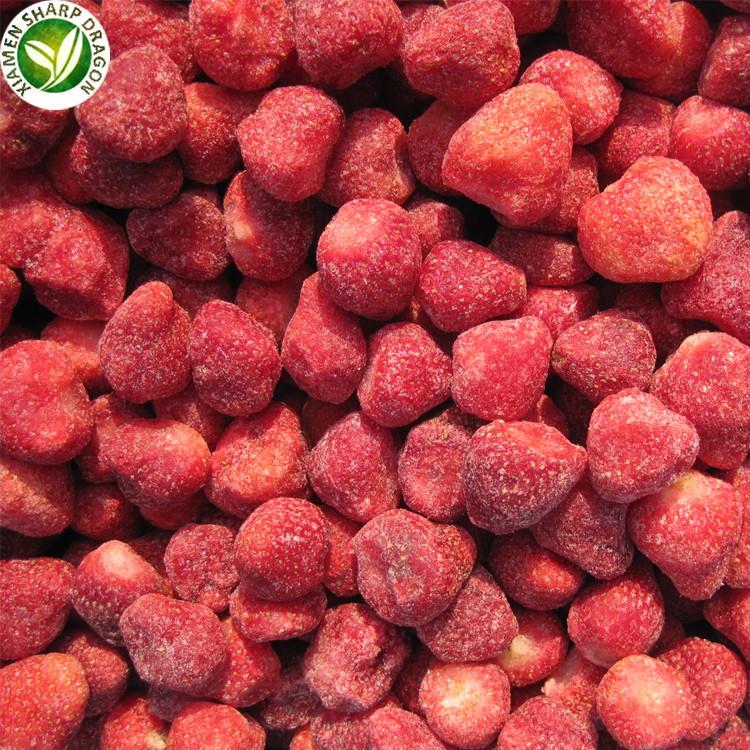
When long-term contact with water is unavoidable, frozen strawberry formats may be a more logical comparison. Frozen and freeze-dried fruit solve different problems. Frozen fruit retains its water and usually softens after thawing; freeze-dried fruit removes most water and is designed around low-moisture handling. The selection should follow the final texture and process, not the assumption that one is universally more premium.
Practical example: cereal with visible strawberry slices
Practical example: take a cereal producer that wants two visible strawberry slices in a 40 g serving. The first sample uses thin slices because they look attractive in a tray. During ribbon blending and case transport, however, many slices break into red fines and the distribution per serving becomes inconsistent. The producer compares a thicker slice with a defined particle-size range, lowers the most aggressive handling step, and tests sealed packs after transport simulation. The better choice is the option that still delivers recognizable pieces at opening, even if the untouched bench sample looked slightly less delicate.

Moisture, Packaging, and Open-Pack Life
Moisture is the central handling risk. University of Minnesota Extension advises packaging freeze-dried foods quickly in moisture-proof, hermetically sealed containers because even ordinary room humidity can affect them. For commercial products, the pack material, seal quality, headspace, secondary packing, storage environment, and number of openings all contribute. "Resealable" describes a closure feature; it does not by itself prove that the package provides the required water-vapor barrier.
A large foodservice pack and a small single-use sachet experience different exposure. If a kitchen opens one bag repeatedly during a humid shift, the last portion may not resemble the first. Smaller inner packs can reduce repeated exposure but increase packaging use and cost. The correct balance depends on daily consumption, the humidity of the work area, closure discipline, and the texture tolerance of the recipe.
The useful evidence is a packaging trial conducted with the proposed product and filling process. Review seal integrity, water-vapor barrier data, product moisture or water activity over time, sensory crispness, caking, and color. XMSD's overview of food packaging considerations can help frame the questions, but the final pack still needs evidence for the actual low-moisture product.

Safety Is Separate from Dry Texture
Safety note: low water activity limits microbial growth during dry storage, but freeze-drying does not reliably kill pathogens. A dry, crisp appearance is not evidence that a ready-to-eat ingredient is microbiologically safe.
This distinction matters because a contaminated organism may survive in a dry food and become active again after moisture returns. The FDA's draft guidance for low-moisture ready-to-eat foods emphasizes sanitation programs, environmental monitoring where appropriate, root-cause investigation, and the limitations of relying only on finished-product testing. Destination requirements and the manufacturer's hazard analysis determine the applicable control plan.
For procurement, request the evidence relevant to the product and market rather than treating one certificate as a substitute for control. Review the ingredient statement, allergen and cross-contact information, microbiological criteria, lot identification, process description, packaging specification, certificate of analysis where agreed, and traceability records. XMSD's certification information is a starting point for supplier review, not proof that every lot automatically meets every destination or application requirement.
A Buyer's Approval Method
Start with a written application brief. State whether the fruit must remain crisp, become soft, disperse, show visible identity, or provide uniform flavor. Name the stage where it is added, the moisture level of the surrounding product, the expected contact time, the mixing method, the finished package, and the target market. This prevents a supplier from optimizing for an attractive dry sample while missing the actual job.
Next, translate the application into measurable acceptance points. These may include form and nominal size, particle-size distribution, allowed fines or broken pieces, sensory description, color range, ingredient status, moisture or water activity, foreign-material control, microbiological criteria, packaging barrier, net weight, and lot documentation. Not every project needs every item, but each included item should have a reason tied to the product.
Then run two trials. The first is a short application trial to screen flavor, color, distribution, rehydration, and processing behavior. The second uses the intended pack and a realistic storage or distribution challenge. Compare the beginning and end of the proposed use period, including open-pack handling if relevant. A sample can pass the first trial and fail the second because moisture migration or breakage takes time.
Finally, set an arrival-inspection method that matches the agreed specification. Inspect outer cases and seals, confirm lot identity, measure or review the agreed moisture-related value, screen piece size and fines using the stated method, and evaluate the ingredient in the same application basis used for approval. XMSD's broader frozen-food solution framework is useful when comparing product forms and shipment requirements, but acceptance should remain tied to the signed specification and intended use.

Practical example: foodservice garnish pack
Practical example: suppose a cafe group uses freeze-dried strawberry pieces as a garnish and consumes about 250 g per location each day. A 1 kg inner bag would stay open for roughly four days, exposing the fruit repeatedly to humid air. The team compares four 250 g inner packs with one 1 kg pack. Although the smaller packs add material and packing cost, the trial shows more consistent crunch and less waste at the end of each day. The decision can then be made from usable garnish yield and operating practice, not package price alone.
How to Recognize a Weak Sample
Softness in an unopened dry pack may indicate moisture uptake, an unsuitable moisture target, or a barrier problem. Extensive fines can point to a fragile cut, excessive handling, or transport damage. Strong browning or dull color may reflect raw material, pretreatment, drying, oxygen exposure, light, or storage. A burnt or cooked note is not explained by the phrase "freeze-dried" and deserves investigation. Uneven piece size can cause inconsistent flavor and rehydration in the finished product.
Powder presents different signals: hard lumps, poor flow, visible foreign particles, nonuniform color, or rapid caking after opening. These observations do not identify the cause by themselves, but they tell the buyer what to examine next - moisture results, sieving data, packaging integrity, storage records, ingredient declaration, and retained samples. The failure we watch for is a supplier answering every issue with a broad quality claim instead of showing a measurement method and lot evidence.
You can make this review repeatable by keeping one approved reference sample, the agreed test method, and photographs of acceptable piece distribution. When a new lot arrives, compare it on the same basis rather than relying on memory. If a difference appears, isolate the affected lot, document the observation, and check the measurement that is most closely linked to the defect. Soft pieces point first toward moisture and pack integrity; excess red dust points toward particle-size distribution and handling; weak flavor points toward sensory comparison and application dosage. This sequence turns a vague complaint into evidence that a supplier and buyer can investigate together.
The Decision in One Sentence
Freeze-dried strawberry is effective when its form, moisture behavior, handling strength, safety controls, and package are designed for the finished application. Choose the format from the job, test it in the real matrix and pack, and approve measurable performance rather than the appearance of one dry sample. Readers comparing food classification and product forms may also find the guide to what type of food a strawberry is useful.
XMSD sourcing note: send the intended application, preferred form, piece size, pack format, destination, and sample test conditions so the discussion begins with performance requirements rather than a generic fruit description.
References
- University of Minnesota Extension: Preserving food at home - Freeze-drying
- USDA Agricultural Research Service: Freeze-Dried Strawberries and Ice Cream Make for a Very Stable Relationship
- FDA: Draft Guidance for Low-Moisture Ready-to-Eat Human Foods
- XMSD operational perspective on fruit form, application trials, packaging, and buyer acceptance.