


Carrot Effects: Benefits, Limits, and Myths | XMSD
Nov 12, 2018

The most reliable effects of eating carrots come from their role as a food: they supply provitamin A carotenoids, contribute dietary fiber, and add vegetable variety. Preparation can change texture and carotenoid availability, while very high carotenoid intake can temporarily color the skin. These effects do not make carrots a cancer treatment or a substitute for medical care.
The short answer: Carrots can contribute beta-carotene for vitamin A, add fiber to the diet, and work in raw, cooked, or frozen meals. Observational research has reported associations between carrot intake and lower cancer incidence, but it cannot prove that carrots prevent lung cancer or any other cancer. Carrots and white radish may also be eaten together; an enzyme reaction measured in prepared vegetables is not a food-safety incompatibility.

What Carrots Reliably Do
A food can support normal body functions without acting like a medicine. For carrots, the clearest evidence begins with composition: orange carrots are a dietary source of beta-carotene and other carotenoids, and whole carrot pieces contribute fiber.
They contribute to vitamin A intake
The NIH Office of Dietary Supplements explains that the body can convert some carotenoids, including beta-carotene, into vitamin A. Vitamin A is needed for normal vision, immune function, reproduction, growth, and development. This supports saying that carrots contribute to vitamin A intake. It does not support promising that extra carrots will sharpen normal eyesight or prevent infection.
They add fiber, but response varies
Whole carrots add dietary fiber. The National Institute of Diabetes and Digestive and Kidney Diseases advises obtaining enough fiber and liquids and increasing fiber gradually. Carrots can be one fiber-containing food in that pattern, but they do not guarantee relief from constipation.

Preparation Changes the Food, Not the Basic Answer
Raw carrots retain a firm structure and crisp texture. Cooking softens the tissue and changes water content, while oil, sugar, salt, butter, or sauce changes the complete dish. A plain carrot and a glazed or creamy carrot dish should therefore not share one nutrition claim.
Composition and absorption are different: a small human study involving eight ileostomy volunteers found greater beta-carotene absorption from a cooked carrot puree meal than from a raw chopped carrot meal under the study conditions. This suggests that processing can affect bioavailability, but it does not make one preparation universally superior.
Cooking may improve access to some carotenoids while reducing or redistributing other compounds. The practical conclusion is to use more than one form according to the meal, rather than ranking raw or cooked carrots as always healthier.

Do Carrots Prevent Cancer?
No single food should be presented as cancer prevention. A 2025 systematic review and meta-analysis of prospective observational studies reported that higher carrot intake was associated with lower cancer incidence. The word associated matters: people who eat more carrots may differ in overall diet, smoking, activity, socioeconomic factors, and other characteristics that are difficult to separate completely.
| Claim | What the evidence shows | Responsible wording |
|---|---|---|
| "Carrots prevent cancer." | Prospective observational studies report associations, not proof that carrots caused the lower risk. | Carrots can be part of a varied dietary pattern. |
| "Carrots prevent lung cancer." | Some observational research reports lower incidence with higher intake, but confounding and dietary-pattern effects remain. | Do not use carrots as a lung-cancer prevention claim. |
| "Beta-carotene supplements prove the carrot effect." | Large supplement trials are not equivalent to ordinary carrot intake and found harm in some smokers and asbestos-exposed groups. | Keep food and high-dose supplement evidence separate. |
The NIH health-professional fact sheet notes that cancer findings from observational studies are mixed. It also reports that high-dose beta-carotene supplements increased lung-cancer risk in clinical trials involving smokers and some asbestos-exposed participants. Those supplement findings should not be transferred to normal carrot portions, but they clearly show why "more beta-carotene prevents lung cancer" is not a defensible message.

Can Carrots and White Radish Be Eaten Together?
Yes. There is no established food-safety reason to avoid eating carrots and white radish in the same meal. The confusion comes from food chemistry involving ascorbate oxidase, an enzyme found in carrot tissue and other vegetables.
Laboratory work confirms that carrot ascorbate oxidase can affect vitamin C during tissue disruption and thermal treatment. A small Japanese cooking study published in 1952 also reported vitamin C loss when grated carrot and grated radish were mixed, with less loss after vinegar was added. That narrow preparation experiment is the likely basis for the familiar warning.
The result does not show that the vegetables become toxic, that all vitamin C disappears, or that the combination has no nutritional value. Cutting, grating, exposure to oxygen, holding time, temperature, acidity, and cooking all influence vitamin C stability. Research on cut vegetables has also measured ascorbate oxidase activity in both carrot and Japanese radish, so the issue is broader than a simple "carrot destroys radish" rule.
Vinegar may change acidity and flavor, but it is not required to make the combination safe. If vitamin C retention is a priority, avoid finely grating vegetables long before service, minimize unnecessary holding after cutting, and obtain vitamin C from a varied diet rather than relying on one mixed dish.
When Carrots Cause a Noticeable Effect
Yellow-orange skin from very high intake
Long-term, excessive beta-carotene intake can cause carotenodermia, a yellow-orange skin color. NIH describes this as harmless and reversible after beta-carotene intake is reduced. It is different from toxicity caused by excessive preformed vitamin A, which usually comes from supplements or certain medicines rather than carrots.
Digestive discomfort after a sudden fiber increase
Some people may notice gas, fullness, or bowel changes when they increase fiber-rich foods quickly. Individual tolerance, portion, the rest of the meal, and fluid intake all matter. Persistent symptoms, a suspected allergy, or a condition requiring a specialized diet should be discussed with a qualified health professional.
A different effect from juice or a prepared dish
Whole carrots, strained carrot juice, sweetened juice blends, soups, cakes, and glazed carrots are not nutritionally identical. Juice changes the food structure, and added sugar, oil, cream, or salt belongs to the finished product. Evaluate the form actually eaten.

Fresh, Cooked, and Frozen Carrots
Fresh carrots suit raw snacks, salads, slaws, and dishes that need a firm bite. Cooked carrots become softer and may release carotenoids differently from raw tissue. Plain frozen carrots offer pre-cut formats and convenient portioning for soups, ready meals, mixed vegetables, stir-fries, and foodservice production.
Freezing does not preserve every nutrient perfectly, and it does not remove every nutrient. The final result depends on the raw material, blanching, freezing, frozen storage, packaging, thawing, and cooking. Product-specific laboratory data is required when a numerical nutrition claim will appear on a label or specification sheet.
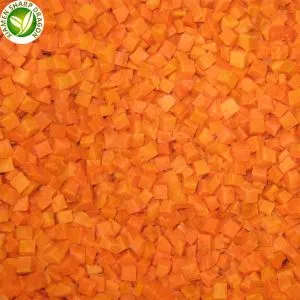
For application performance, cut shape often matters more than a general fresh-versus-frozen argument. Dice distribute evenly, slices remain visible, strips work in stir-fries and blends, and crinkle or flower cuts create a more distinctive appearance.
What Frozen-Carrot Buyers Should Check
For B2B purchasing, avoid turning general carrot research into a product claim. Confirm the ingredient form, blanching level, cut dimensions, defect tolerance, color range, texture after cooking, free-flowing condition, packing format, and any destination-market labeling requirement.
Our current IQF frozen carrot page lists dice, slices, strips, crinkle cuts, and customized formats for retail, foodservice, and processing applications. We recommend testing the selected cut in the buyer's actual recipe because sauce, heating, holding time, and surrounding ingredients affect the finished result.
Packing should be discussed with the application and distribution channel. Buyers can review our frozen packaging overview and frozen food solutions before defining a sample and specification.

XMSD sourcing note: Share the intended dish, preferred cut, packing format, and destination market. We can then discuss a relevant frozen-carrot specification, sample evaluation, and quotation without attaching unsupported medical claims to the product.
Frequently Asked Questions
1. What are the main effects of eating carrots?
Carrots contribute provitamin A carotenoids, fiber, and vegetable variety. Preparation changes texture and nutrient availability, while very high long-term beta-carotene intake can temporarily color the skin.
2. Do carrots improve eyesight?
Carrots can supply beta-carotene for vitamin A, which is required for normal vision. Eating more carrots will not necessarily sharpen normal eyesight or correct an eye problem caused by another condition.
3. Do carrots prevent cancer?
No food should be described as cancer prevention. Observational studies report associations between higher carrot intake and lower cancer incidence, but they cannot prove that carrots caused the difference.
4. Can carrots prevent lung cancer?
The evidence does not support promising that carrots prevent lung cancer. Smoking avoidance and evidence-based screening or medical guidance should not be replaced by a single-food claim.
5. Are beta-carotene supplements the same as eating carrots?
No. High-dose supplements deliver concentrated compounds outside the whole-food matrix. Clinical trials found increased lung-cancer risk from beta-carotene supplements in some smokers and asbestos-exposed participants.
6. Can carrots and white radish be eaten together?
Yes. The combination is not an established food-safety problem. Enzyme activity can influence vitamin C during cutting and holding, but that does not make the vegetables incompatible or toxic.
7. Do carrots destroy all the vitamin C in white radish?
No. A historical grated-vegetable experiment found some vitamin C loss under its preparation conditions. It did not show that all vitamin C disappears in every recipe or that the complete meal loses its nutritional value.
8. Is vinegar required when cooking carrot and radish?
No. Vinegar can change acidity and flavor and reduced vitamin C loss in an older grated-vegetable experiment, but it is not required to make carrot and radish safe to eat together.
9. Are raw carrots better than cooked carrots?
Neither form is always better. Raw carrots keep a firmer structure, while cooking softens the tissue and can improve carotenoid absorption under some conditions. The finished recipe also matters.
10. Do frozen carrots still have nutritional value?
Yes. Plain frozen carrots still contain fiber, carotenoids, and other nutrients. Exact retention depends on raw material, blanching, freezing, storage, packaging, and cooking.
11. Can eating many carrots turn the skin orange?
Very high, long-term beta-carotene intake can cause a yellow-orange skin color called carotenodermia. NIH describes it as harmless and reversible when intake is reduced.
12. Can carrots be eaten every day?
Most people can include carrots regularly, but dietary variety remains important. Portion, preparation, digestive tolerance, and any condition-specific dietary advice should guide individual choices.
13. Which frozen carrot cut is best for food manufacturing?
There is no universal best cut. Dice distribute evenly, slices stay visible, strips suit stir-fries and blends, and decorative cuts change presentation. Confirm dimensions and test the product in the actual process.
Final Thoughts from XMSD
The useful carrot story is nutritional and practical: carotenoids, fiber, varied preparation, and adaptable food formats. Cancer prevention, guaranteed eyesight improvement, and forbidden carrot-radish combinations go beyond the evidence. For frozen-carrot buyers, define the cut, blanching, application, packing, and labeling requirements before making any product claim.
References
- NIH Office of Dietary Supplements: Vitamin A and Carotenoids-Consumer
- NIH Office of Dietary Supplements: Vitamin A and Carotenoids-Health Professional
- NIDDK: Eating, Diet, and Nutrition for Constipation
- Ojobor et al.: Carrot Intake and Cancer Incidence-Systematic Review and Meta-Analysis
- Livny et al.: Beta-Carotene Bioavailability from Differently Processed Carrot Meals
- Leong and Oey: Endogenous Ascorbic Acid Oxidase and Vitamin C in Carrots
- Yamada and Tohya: Mixing Grated Carrot and Radish and Vitamin C Loss
- Oba: Vitamin C and Ascorbate Oxidase Activity after Cutting Vegetables
- XMSD: IQF Frozen Carrot Product Forms and Applications