


Frozen Carrot Dice vs Slices: Cut Size and Texture Guide | XMSD
Apr 15, 2019

This old article originally promised that carrots could treat night blindness, slow aging, kill bacteria and improve digestion. Those claims do not help you approve a frozen ingredient, and several overstate the evidence. We already have a separate XMSD article on beta-carotene and vitamin A. This guide answers a different commercial question: should you buy frozen carrot dice, straight slices, crinkle slices, strips or decorative cuts for the finished application?
Cut style changes more than appearance. A 10 millimeter dice can distribute evenly through fried rice or soup. A thin round can cook quickly but break during mixing. A crinkle slice has a larger visual surface and can hold sauce differently. A long strip can suit stir-fry but expose fiber and length variation. Blanching, raw-material maturity, core ratio and downstream cooking decide whether any of these cuts remains tender and bright.
Approve the exact product state rather than a category name. Define the carrot variety or agreed type, peel and crown trim, cut geometry, in-band distribution, color, defects, blanching route, frozen separation, cooked tenderness, flavor, usable yield, packing and cold-chain evidence. Run the same representative application test on every offer before comparing price.
The short answer: Choose dice for uniform distribution and portioning, slices for visible identity, crinkle cuts for a distinctive surface, and strips for directional applications such as stir-fry. Then control the distribution, not just the nominal size. Verify raw-material maturity, cortex and core, peeling, blanching, color, woody or fibrous pieces, cracks, cooked texture, free flow and usable cost in the actual formula.

Choose the Cut From the Application Backward
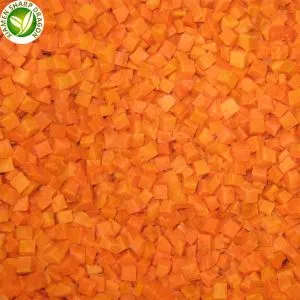
Start with finished-food geometry. Dice suit recipes that need distribution across many portions: fried rice, soup, fillings, vegetable blends and ready meals. State the nominal three dimensions, permitted rectangular pieces, fines and oversize. A visual 10 millimeter cube may still vary enough to disturb depositor flow or cook uniformity.
Straight rounds display the root cross-section and help the customer recognize carrot immediately. Specify diameter classes, slice thickness and taper. Large shoulder slices and small tip slices cook at different rates. Decide whether the program deliberately mixes diameter classes or uses a restricted root size.
Crinkle slices add a ridged surface and can provide stronger visual texture. The ridge depth, cutter pitch, maximum thickness and edge integrity matter. Shallow, inconsistent grooves can disappear after cooking; very deep cuts can create fragile peaks and more broken material. Approve both frozen appearance and cooked bite.
Strips need cross-section and length distributions. A nominal 4 by 4 by 30 to 50 millimeter strip must define how short pieces, tapered wedges and long curved cuts are classified. For stir-fry, test tangling, breakage and bite. For mixed vegetables, align strip length with the other components so one ingredient does not dominate the package visually.
The XMSD frozen carrot category presents dice, slices, strips and customized formats as different starting points. Use it to identify the intended family, then request the current technical sheet, representative sample, process flow and partner-facility scope. The page name does not replace a signed cut distribution.

Raw-Material Maturity Controls Core, Fiber and Color
Write Daucus carota when botanical identity is needed, plus the cultivar or agreed commercial type, origin, crop window and raw-root size class. Similar orange color does not prove identical cortex thickness, core ratio, sweetness, fiber or blanching response. Ask for a representative cut face and cooked sample across crop periods.
UC Davis describes high-quality fresh carrots as firm, straight, uniformly tapered, bright orange, with little root hair, no green shoulder or green core, and low bitterness. It notes that harvest decisions depend on market and that length can guide processing efficiency for cut-and-peel carrots. These criteria help frame incoming raw-material control before frozen processing begins.
USDA carrots-for-processing standards use defect terms such as soft rot, growth cracks, sunburn, green core, pithy core, watercore, internal discoloration, freezing damage, dry rot, insects and mechanical damage. Build a photo scale from the categories relevant to your product. Keep decay, foreign material and other safety-relevant findings outside one general cosmetic total.
Carrot core and cortex can differ in color and texture. A large pale core may be visually obvious in a slice but distributed across a dice. Define an accepted core-color range or cortex-to-core relationship if the finished product is sensitive. Test tenderness after the customer cook because a hard or woody center cannot be judged from outer orange color alone.
Review raw-lot records: cultivar, field or receiving lot, harvest maturity, root size, pre-cooling or raw storage, wash, peeling, crown and tip trim, time to cutting and rejected defects. Freezing preserves much of the selected material's structure; it does not turn a woody, bitter or decaying root into tender premium slices.

Measure Size as a Distribution, Not One Average
USDA frozen-carrot standards recognize different styles and evaluate size and shape uniformity along with color, defects and tenderness. Grade A, except for the chips style, requires similar varietal characteristics, normal flavor and odor, good color, practical size and shape uniformity, practical freedom from defects, tenderness and at least 90 points. Grade B requires at least 80 points under its framework.
Codex CXS 320-2015 also identifies carrot styles and size grading. Use these standards as vocabulary and reference, not as a hidden contract. State the actual style, nominal dimensions, sampling, measurement state, permitted distribution and lot action. Destination requirements and customer expectations may be tighter or use a different method.
Specify frozen or thawed measurement, sample conditioning, caliper or template, orientation and rounding. For dice, control three dimensions. For slices, control thickness and diameter. For strips, control two cross-section dimensions and length. For decorative pieces, use a shape template plus mass or maximum dimension where a caliper cannot describe the design.
Worked example: A ready-meal producer samples 500 frozen carrot dice from ten cartons. The specification requires 8 to 12 millimeters on the controlling dimensions, at least 90% in band, no more than 4% undersize and no more than 5% oversize by count. The sample contains 458 in-band pieces, 17 undersize, 18 oversize and 7 irregular fragments. In-band is 91.6%, undersize 3.4% and oversize 3.6%; all three size rules pass. Color, woody core, blanching, breakage and cooked tenderness still require separate acceptance.
Use count and mass where the tails can mislead. Many tiny fines may dominate count but contribute little mass; a few large wedges may dominate mass and center-cook risk. Trend both when the product feeds a depositor or must deliver uniform visual portions. Photograph the composite before sorting so the distribution remains auditable.
The XMSD frozen carrot strips reference provides a strip-style discussion point. Lock cross-section, length distribution, short pieces, wedges and cooked bite before treating the nominal size as an approved specification.

Blanching Must Fit the Cut and Customer Cook
A typical frozen-carrot route may include receiving, washing, peeling, trimming, cutting, size screening, blanching to control enzymes, cooling, draining, IQF freezing, inspection and packing. The real sequence and parameters depend on cut, raw material and product. Request the actual flow rather than assuming all orange frozen pieces received the same treatment.
Codex quick-frozen vegetable principles call for suitable preparation and enzyme deactivation where required before rapid passage through the maximum ice-crystallization range. Blanching is therefore a control step, not a quality slogan. Record piece class, load, medium, time, temperature, cooling, drainage and verification for the proposed route.
Under-blanching can leave unwanted enzyme activity and quality drift. Over-blanching can soften thin slices, weaken ridges and reduce the texture left for the customer cook. One thermal schedule may not suit a 10 millimeter dice, a thin round and a decorative flower. Compare the largest and smallest pieces after the same shelf-life point.
Fix the downstream cook. For soup, record carrot percentage, liquid, vessel, time and agitation. For fried rice, control pan or kettle load, oil, time and mixing. For a ready meal, assemble the full formula, freeze and reheat. For a retail side dish, test the named consumer appliance and hold. Measure color, characteristic flavor, bitterness, core tenderness, fracture and piece integrity.
Define tenderness with a method. A sensory scale can record hard, firm-tender, tender and mushy using approved anchors. An instrument can measure force only if sample temperature, orientation, probe and speed are fixed. Report the spread, not only the average, because one hard core or soft fragment can matter in a visible retail pack.
If the application is strip-like or fried, the XMSD frozen carrot fries reference can frame product-form questions. Confirm whether the item is plain, blanched, pre-fried, coated or seasoned because those states change ingredients, allergens, cooking and yield.

Use Non-Overlapping Defect Categories
Frozen inspection and cooked inspection answer different questions. Frost can hide pale tissue or cracks. Thawing can reveal water-soaked areas but also changes firmness. Set the state, lighting, background and timing for every defect category. Use photo anchors and retained reference samples where practical.
| Finding | Measurement | Decision focus |
|---|---|---|
| Peel or crown tissue | Affected area, unit count and severity | Review peeling and trim |
| Green, pale or dark core | Cut-face color scale and cooked test | Review maturity and root class |
| Crack or split | Length, depth and broken mass | Review raw damage, cutter and handling |
| Woody or fibrous piece | Fixed cook and bite or shear class | Review cultivar, maturity and core |
| Loose ice or clump | Ice mass, cluster mass and separation force | Review drainage, IQF, seal and cold chain |
| Decay or foreign material | Named category, size, count and escalation | Hold and investigate separately |
Keep flavor findings distinct. UC Davis notes that ethylene exposure can induce bitter flavor in carrots and that bitterness can also relate to preharvest stress. Record characteristic sweetness, earthy notes, bitterness and off-odor after the standardized cook. Investigate raw storage, neighboring commodities, maturity and processing rather than masking the result with sauce.
Use decorative cuts only when they improve the customer's product. A flower shape can add visible value in a premium mix but carries more edge damage and needs its own template. The cut should not conceal a loose size distribution or replace checks for core color, blanching and tenderness.
Approve Carrot Inside the Complete Formula
A carrot can pass alone and fail in a blend. Thin slices may soften before peas or beans are ready. Dense dice may remain hard after the surrounding sauce reaches serving temperature. Bright orange pieces may dominate the intended color balance. Test the full ingredient ratio, sauce, salt, acid, fat, freeze-thaw cycle and reheating route.
For vegetable mixtures, specify carrot cut and blend ratio together. The XMSD carrot, green bean and corn mix reference shows why component size, color, ratio and IQF separation must be coordinated. Approve each component and the blended composite.
Measure portion consistency across bags. Small dice can migrate into voids while larger slices and strips remain near the top or catch in filling equipment. Sample multiple pouches or carton positions and compare component ratio by mass. Review blending, transfer height, vibration and filling if segregation appears.
Record performance after the real hold. Foodservice vegetables may wait in a steam table; ready meals may spend time between reheating and consumption. Compare zero-minute and end-of-hold color, tenderness, shape and flavor. A slightly firmer starting carrot can outperform a tender sample after a long hold, while the reverse may be true for a short microwave cycle.
Calculate Usable Carrot, Not Delivered Weight
Delivered price can hide loose ice, peel, out-of-size pieces, broken material, pale or green core, woody texture and excess cooking loss. Define non-overlapping deductions and calculate usable output in the intended application. Keep decay, illegal residues and food-safety failures outside the commercial calculation.
Practical example: A 1,000-kilogram frozen carrot lot costs USD 1,180 delivered. The signed frozen and application test finds 14 kilograms of loose ice, 39 kilograms of out-of-size pieces and fines, 18 kilograms of peel or crown tissue, 24 kilograms of pale, cracked or damaged material, 35 kilograms of woody or overly soft pieces and 40 kilograms of excess cook loss. No mass is counted twice. Usable output is 830 kilograms, so cost is USD 1,180 divided by 830, or about USD 1.42 per usable kilogram. A USD 1,230 offer yielding 900 kilograms costs about USD 1.37 per usable kilogram and may be commercially better if all safety and document gates pass.
Calculate by application. A puree line can use broken pieces but rejects fiber. A retail crinkle-slice pack values shape and color. A soup producer may accept wider diameter variation if the center cook remains uniform. Document the approved exception instead of applying one cosmetic limit to every channel.
Trend crop and process data: size distribution, cortex and core appearance, color, bitterness, peel, cracks, blanching, free ice, cooked texture and yield. A shift can point to root size, maturity, raw storage, blade setting, thermal treatment, drainage or cold-chain handling before complaints appear.
Food Safety, Packing and Cold Chain Complete Approval
Freezing does not sterilize carrots. Define whether the product is ready to cook, intended for a validated further heat process or ready to eat. FDA explains that bacteria can survive freezing and that ready-to-cook frozen foods should follow validated package cooking directions. Blanching for quality does not automatically establish a kill step or ready-to-eat status.
Set microbiological requirements by organism, method, sample unit, sampling plan and lot action. Review water, wash, peeling, cutting, blanching, cooling, environmental controls, freezing, foreign-material prevention and packing. Confirm pesticide-residue requirements against the actual destination and crop program.
Traceability should connect field or receiving lot, cultivar, harvest and storage, wash and peel run, cutter, blanching record, freezer batch, inspection, metal detection or agreed foreign-material control, packing code, cold-store position and shipment. Verify the certificate holder, facility address, product scope and validity for the proposed route.
Choose a pack that protects the cut. Small dice need reliable seals and portion control. Crinkle slices and decorative cuts need space and carton strength to limit fracture. Strips need protection from compression and vibration. Measure fines and breakage at production release and arrival using the same method.
Define loose ice, cluster mass and separation force. Check multiple cartons and pallet positions. Codex quick-frozen principles use product temperatures of minus 18 degrees C or colder through the frozen chain, subject to permitted tolerances. Write the set point, logger position, review owner, permitted deviation and receiving action.
For soups, sauces, ready meals and mixed-vegetable programs, the XMSD food-processing buyer route helps organize cut, formula, process, pack and evidence inputs. We review a suitable product and partner-facility scope order by order.

Use a Stage-Gated Frozen Carrot Approval
Close the application and cut style before comparing prices. Dice, straight slices, crinkle slices, decorative pieces and strips have different distribution, breakage and cooking risks. Give each gate a record, owner and lot action.
- Lock identity: Daucus carota, cultivar or type, origin, crop, root class, peel and trim.
- Lock application: soup, fried rice, stir-fry, side dish, puree, ready meal, retail pack or blend with a standard cook.
- Set geometry: style, dimensions, in-band percentage, undersize, oversize, fines, wedges and breakage.
- Set quality: color, cortex and core, peel, cracks, woody tissue, bitterness, decay, ice and clumps.
- Validate processing: cutting, blanching, cooling, drainage, IQF, cooked tenderness, flavor, shape and usable yield.
- Verify safety: intended use, microbiology, residues, foreign material, traceability, facility scope and cooking directions.
- Validate delivery: bag, carton, pallet, frozen-chain record, arrival inspection and shelf-life application trial.
Send the carrot type, required dice, slice, crinkle or strip distribution, core and defect rules, blanching state, cooking method, pack, destination, volume and evidence list. We can review a suitable frozen carrot product and partner-facility route before quotations are treated as comparable.
XMSD sourcing note: Tell us the cut style, size distribution, core and defect limits, blanching state, cooking method, pack and destination. We will review a suitable IQF frozen carrot route and the required evidence.
Discuss Your Frozen Carrot RequirementFrequently Asked Questions
Are frozen carrot dice and slices made from the same raw-root size?
Not necessarily. Root diameter, taper, cultivar and cut yield can differ by program. Define the raw-root class, finished distribution, core appearance and cooked texture rather than assuming the same input.
Should frozen carrot size be checked frozen or thawed?
Use the state written in the contract. Frozen checks support receiving and portioning; a controlled cook supports tenderness and application performance. Keep sample conditioning and measurement identical across suppliers.
Why can one carrot slice taste bitter?
Bitterness can relate to preharvest stress, cultivar, root tissue or ethylene exposure during raw storage. Record the cooked finding and review raw-lot and storage evidence instead of averaging it into color.
Does blanching make frozen carrots ready to eat?
Not automatically. Blanching may be designed for enzyme control rather than a validated kill step. Ready-to-eat status requires process validation, post-process controls, microbiological evidence and appropriate labeling.
Which carrot cut works best in a frozen vegetable blend?
Choose the cut that matches the other components' size, cook time and visual role. Validate component ratio, segregation, reheating and hold; nominal millimeters alone cannot select the best style.
References
- USDA Agricultural Marketing Service, Frozen Carrots Grades and Standards. Style, size and shape uniformity, color, defects, tenderness and grade framework.
- USDA Agricultural Marketing Service, Carrots for Processing Grades and Standards. Firmness, woody tissue, green and pithy core, watercore, internal discoloration, cracking, disease and damage vocabulary.
- UC Davis Postharvest Research and Extension Center, Carrot. Maturity, root quality, bitterness, ethylene response, white blush, cracking, color and storage context.
- Codex Alimentarius, Standard for Quick Frozen Vegetables, CXS 320-2015. Quick-frozen carrot identity, styles, sizing, preparation, enzyme deactivation and frozen-chain principles.
- USDA, United States Standards for Grades of Frozen Carrots. Detailed scoring, style, size, defect and character methods.
- U.S. Food and Drug Administration, Ready-to-Cook Food Safety. Bacterial survival during freezing and the need to follow validated cooking directions.
- Codex Alimentarius, General Standard for the Labelling of Prepackaged Foods, CXS 1-1985. Product identity, ingredients, lot, date, storage and non-misleading presentation.
Disclaimer: This article provides general frozen-food procurement and product-development information, not medical, legal or process-validation advice. Base identity, specifications, processing, intended use, food-safety controls, labeling and compliance on the actual product, partner facility, destination market and application.