


China Bayberry Supply Calendar: Cultivar and IQF Planning
Apr 25, 2019

A workable China bayberry supply plan starts with the fruit that will reach your process, not with one national harvest date. Cultivar, growing area, altitude, weather and maturity shift the picking window. Fruit size changes the number of pieces per kilogram. Ripeness affects color, acidity, juice release and damage risk. The time between picking, cooling and freezing can then decide whether the finished lot contains separate whole fruit or soft, leaking and broken units.
For an IQF program, we recommend locking five connected items before the season: botanical and cultivar identity, an updateable harvest window, a raw-fruit maturity standard, a finished-product size and defect specification, and an application test. Published research gives useful comparison points for Biqi, Dongkui and other Chinese bayberry cultivars, but study results are not automatic purchase limits. Convert them into a sample, measurement method and acceptance decision that fit your beverage, jam, dessert or whole-fruit use.
The short answer: treat the bayberry season as a controlled sequence, not a fixed date. Update crop timing during flowering and color change, approve raw fruit at the factory intake, measure usable yield and size distribution, freeze without avoidable delay, and release the IQF lot only after frozen and post-thaw checks.
Start with the correct fruit identity
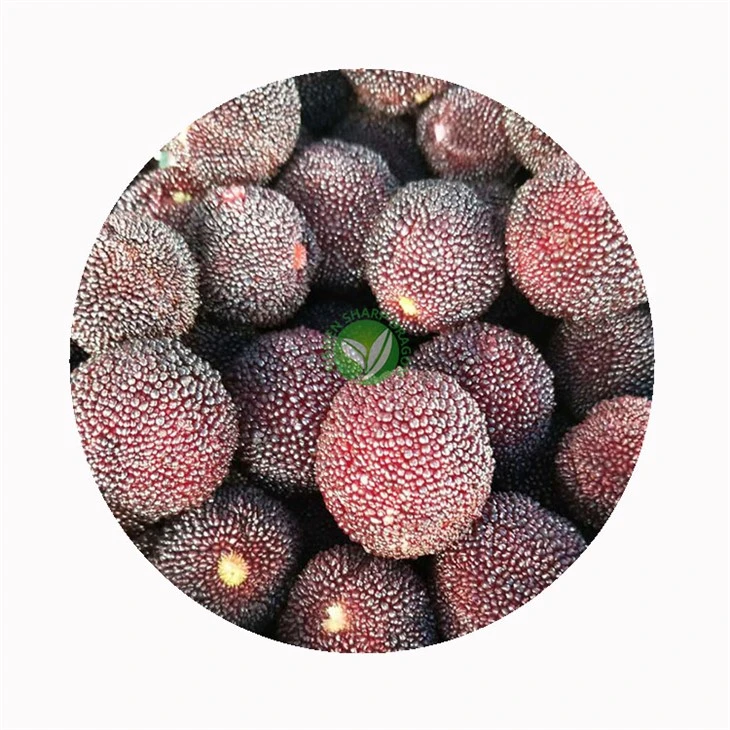
Chinese bayberry is commonly called yangmei, waxberry or yumberry in commercial conversations. Scientific literature may use Myrica rubra or the updated genus name Morella rubra. Put the accepted commercial name and botanical identity on the specification so the inquiry cannot be confused with unrelated plants that also carry the word "bayberry." State whether you need fresh fruit, whole IQF fruit, puree, juice material or canned fruit; those forms require different maturity, appearance and logistics decisions.
Cultivar also belongs on the technical discussion. "Chinese bayberry" alone does not define average mass, color, stone-to-flesh relationship, sweetness, acidity or storage behavior. If a named cultivar is unavailable, the replacement should be assessed against the same measurable requirements and application trial rather than accepted as an equivalent by name.

Treat the harvest window as a moving range
A calendar should show earliest expected intake, main-volume weeks, latest acceptable intake and the dates when each estimate will be revised. Research on Biqi and Dongkui confirms why one date is inadequate. A 2025 Food Chemistry study describes Biqi as an earlier cultivar, commonly harvested around 9 to 12 June in its study context, while Dongkui is generally at least one week later and often harvested in the second half of June. Those dates describe studied material and should not be applied unchanged to every Chinese growing area or crop year.
Temperature, rain, altitude and orchard load can move maturity. A high-altitude orchard may start after lower orchards in the same district, while heavy rain near harvest can change intake quality and daily processing capacity. Ask for updates at decision points rather than daily promises months in advance: initial crop estimate, post-flowering update, pre-harvest color update, first commercial picking, peak intake and closing forecast.
| Calendar signal | Evidence to request | Decision it changes |
|---|---|---|
| Cultivar and growing area | Orchard or intake source, cultivar record and expected sequence | Sampling dates and likely size/color profile |
| Pre-harvest maturity | Color distribution, soluble solids, acidity and representative fruit photos | Whether to open intake or wait |
| Daily intake condition | Harvest time, arrival time, temperature, rain exposure and defects | Accept, segregate, downgrade or reject |
| Usable yield and line capacity | Sorted input, accepted output, removal reasons and hourly throughput | Raw-fruit commitment and production days |
Decision rule: use the named research window to plan when monitoring begins, not to guarantee shipment. Convert the current crop update into a range with a review date. If the start moves by five days, the consequence should be visible in sample timing, packaging readiness, vessel choice and the latest acceptable production date.

Use cultivar evidence without turning it into a universal grade
Cultivar research is most useful when it shows which variables deserve measurement. A study of fourteen mature bayberry cultivars collected from major Zhejiang production areas reported a highest mean single-fruit weight of 22.27 g for Dongkui and a lowest of 8.35 g for Biqi in that sample set. It also evaluated juice-processing characteristics. These figures demonstrate a large practical difference in pieces per kilogram and processing behavior; they do not establish mandatory commercial weights for every Dongkui or Biqi crop.
Worked example: if a delivered lot actually averaged 22.27 g per fruit, 1,000 g would contain about 45 fruit before sorting. At 8.35 g, the same kilogram would contain about 120 fruit. A 200 g dessert portion would therefore hold roughly 9 larger fruit or 24 smaller fruit before breakage and weight variation. Use this calculation to design a count and size-distribution check, then measure the real lot; do not use a literature average as the invoice specification.
Color names need the same discipline. "Red," "dark red" and "purple-red" are too broad when appearance drives a beverage, sauce or retail pack. Approve a representative frozen sample under defined lighting, record the allowed distribution and test the color after the intended thaw or processing step. If blending lots or cultivars is allowed, state how color and flavor uniformity will be judged.
Make maturity and intake condition release gates
Chinese bayberry is delicate and is normally valued at a mature, juicy stage. That creates a trade-off: fruit picked too early may lack the desired color and flavor, while fruit picked too late may arrive soft and lose juice during washing, sorting and freezing. Define maturity using more than one signal. Color distribution, soluble solids, titratable acidity or a ratio, firmness, flavor, decay, mechanical damage and time from harvest can all change the decision.
A 2024 Horticulturae study compared five cultivars at 25°C and 4°C and found cultivar-specific postharvest behavior. The authors recommend immediate refrigeration for fast-ripening cultivars such as Biqi and Dongkui. Another 2024 study stored Dongkui fruit at 0°C, 4°C, 10°C and 20°C for 12 days and reported faster deterioration as temperature increased. These controlled studies support prompt temperature management, but they do not prove a universal commercial shelf life for fruit exposed to different harvest, sanitation, packaging and transport conditions.
At intake, sample more than the top layer. Record container identity and take fruit from different positions or harvest lots. Separate decay, crushing, leaking, undercolor, overmaturity, stem or leaf, field material and undersize rather than hiding them in one total-defect number. Retain photos and a sample when a load is downgraded, because raw-fruit condition will later affect any discussion about broken units or drip loss in the frozen lot.
Select the product form from the application
Fresh, IQF and canned bayberry solve different problems. Fresh fruit preserves the immediate eating experience but needs a short, tightly managed route. IQF fruit extends the use window and supports frozen distribution, yet thawed texture will not be identical to fresh. Canned fruit accepts heat processing and syrup in exchange for shelf-stable logistics. Decide from the finished product rather than assuming that the most visually attractive form is automatically the best ingredient.
| Form | Primary value | Approval focus |
|---|---|---|
| Fresh | Fresh eating and premium seasonal presentation | Maturity, rapid cooling, bruising, transit time and destination access |
| Whole IQF | Frozen inventory, portioning and processing flexibility | Size, color, whole-fruit condition, separation, broken units and post-thaw behavior |
| Canned | Shelf-stable distribution and ready-to-use dessert or beverage service | Drained weight, whole-fruit integrity, syrup, thermal process, seam and carton condition |
For frozen projects, review the current XMSD IQF Chinese bayberry format alongside your own requirements. If ambient distribution and syrup-packed fruit fit the final channel better, compare the separate XMSD canned bayberry format. These pages are format references; the order specification and approved sample control the actual project.

Translate the crop into an IQF acceptance specification
A seasonal purchase contract needs measurable finished-product language. Start with the intended application, then define the variables that can be checked on a representative lot. Whole-fruit percentage alone is not enough if a beverage line accepts broken fruit but cannot tolerate stems, leaves or hard field material. A retail pouch may accept less variation in size and color than a puree process, even when both buy the same species.
| Specification item | Measurement basis | Failure signal |
|---|---|---|
| Identity and cultivar | Raw-material record and agreed naming | Undisclosed substitution or mixed identity |
| Size distribution | Diameter bands, sample count and whole-lot sampling plan | Average passes but too many pieces fall outside the working band |
| Whole and broken fruit | Weight or count basis stated in advance | Fragments hidden below intact fruit |
| Separation and frost | Frozen inspection at a named sample temperature | Clusters, excess free ice or evidence of temperature abuse |
| Post-thaw performance | Fixed thaw method, time, temperature and drip collection | Excess juice loss, collapse, off-odor or unsuitable color |
Define how each result is calculated. If broken fruit is measured by count, one shattered large fruit can create many fragments and distort the result; a weight basis may describe processing loss more directly. If size is important, report the percentage in each diameter band instead of only the mean. Use calibrated tools, retain the raw data and keep the same sample-conditioning method for pre-shipment and arrival checks.

Calculate raw-fruit need from measured usable yield
Gross crop tonnage is not the same as finished IQF output. Sorting can remove decay, crushing, undercolor, overmaturity, stems, leaves and undersize fruit. Washing and handling can expose weak fruit that looked acceptable at delivery. Production planning should therefore use a measured usable-yield range from representative early lots, with the causes of loss recorded separately.
Worked example: suppose your program needs 10,000 kg of released IQF bayberry. If early commercial runs show a 78% usable yield from accepted raw fruit, the theoretical raw requirement is 10,000 ÷ 0.78 = 12,821 kg. At an 82% yield it is 12,195 kg, a difference of 626 kg. If the line releases 2,400 kg of finished product per day, plan at least 4.17 production days before downtime, changeover, inspection and hold stock. Replace every illustrative number with the current crop's measured results before committing the final volume.
Do not improve the apparent yield by moving defects into the finished product. A lower raw-fruit price can produce a higher usable cost when sorting loss, broken fruit and line interruption rise. Track raw cost, accepted output, labor or line time, packaging loss and final application yield. For puree or jam, some cosmetically imperfect but sound fruit may remain usable under an approved grade; retail whole fruit normally needs a different threshold.
Freezing rate and frozen storage affect the evidence you see
Bayberry's delicate surface and high juice content make freeze-thaw damage commercially important. A 2020 Food and Bioproducts Processing study compared bayberries frozen under several experimental conditions and then stored at -18°C for six months. Faster freezing produced better quality measures after storage and thawing in that study. Its best reported cryogenic condition was specific to the experimental equipment; it is evidence for controlling the freezing process, not a universal factory setting.
A 2010 frozen-storage study on Dongkui reported less post-thaw juice loss and better texture at -40°C than at -18°C under its test conditions. More recent 2026 research is exploring pre-immersion and other treatments to improve non-cryogenic freeze-thaw quality. These studies show that "stored frozen" does not erase process history. For procurement, compare lots with a repeatable thaw test, verify the contracted storage and transport temperature, and treat new pretreatments as order-specific processes that need ingredient, residue, regulatory and sensory review.
Practical example: thaw two 1.00 kg composite samples in identical covered containers at the agreed temperature. Weigh the separated liquid after the same time, calculate liquid mass ÷ initial frozen sample mass × 100, and record whole-fruit integrity, texture, color and odor. The percentage is comparable only when sample history and method stay the same.

Build the acceptance test around the final application
Beverage and puree
Measure extractable yield, soluble solids, acidity, color, aroma, seed removal behavior and sediment under the actual process. Whole-fruit appearance may be secondary, but decay, foreign material and abnormal odor are never solved by crushing. Run a small production simulation with the intended thawing, pulping, filtration and heat sequence.
Jam, sauce and bakery filling
Judge fruit-to-seed yield, acid and sugar adjustment, heating response, final color and target piece identity. A softer fruit may be acceptable for a smooth sauce yet unsuitable where visible fruit pieces carry the product claim. Test the real recipe because pectin, sugar, heat and concentration can magnify differences that are subtle in the raw sample.
Retail, dessert and foodservice whole fruit
Size distribution, color, whole-fruit rate, clumping, frost, package protection and post-thaw presentation carry more weight. Evaluate the exact portion and service method. If fruit is placed on a dessert while partly frozen, the test should include the hold time before consumption. If it is thawed in a foodservice kitchen, include the container, load and refrigeration practice.
Industrial trials should pass through the actual equipment. The XMSD food-processing application route can help organize the inputs to discuss, but your release decision should use recorded line results: throughput, separation, loss, equipment blockage, seed handling and finished-product sensory performance.

Turn the season into a gated approval sequence
The order of decisions matters. Packaging printed too early can become unusable if cultivar, size or product form changes. A frozen sample approved without its raw-fruit and process records cannot explain later variation. Use a sequence in which each gate creates evidence for the next one.
- Lock the application and format. State whether the fruit will be sold whole, thawed for dessert, pulped, filtered, cooked or canned.
- Issue the draft specification. Name identity, cultivar position, maturity signals, size bands, defects, frozen condition, test methods, pack and documents.
- Open the crop watch. Record growing area, expected cultivar sequence, earliest and latest range, weather risks and the next update date.
- Approve intake. Check representative raw fruit for maturity, temperature, damage, decay and foreign material before volume processing.
- Validate usable yield and freezing. Reconcile sorted input, rejected material, accepted output, throughput and frozen-condition results.
- Run the application trial. Use the actual thaw, processing, recipe, portion, equipment and hold conditions.
- Release pack and shipment. Match approved artwork, inner liner, carton, lot code, pallet plan, temperature evidence and required documents.
Set a change-control trigger at each gate. A later cultivar, a revised size band, rain-damaged intake or a lower usable yield can change sample results, quantity or timing. Record who reviews the change, which earlier approval must be repeated and whether the consequence reaches artwork, purchase quantity or shipment. Without that rule, a seasonal adjustment can pass through several departments while the original sample remains the only visible benchmark.
The XMSD frozen packaging overview provides a useful starting point for liner, bag, label and carton discussions. The final material and pack pattern must match fruit size, sharp or damaged surfaces, net weight, pallet handling, destination labeling and the approved frozen route.
Frequently Asked Questions
Is there one fixed Chinese bayberry harvest month?
No. Cultivar, region, altitude, weather and crop year shift the window. Use published dates as orientation, then maintain a current range with named review points. The final production plan should follow actual maturity and intake evidence.
Is Dongkui always larger than Biqi?
Research samples show meaningful cultivar differences, including a Zhejiang study in which Dongkui had the highest and Biqi the lowest mean single-fruit weight among fourteen cultivars. That does not guarantee every commercial lot. Specify diameter distribution and measure the delivered batch.
Can frozen bayberry be judged only while frozen?
No. Frozen inspection reveals separation, frost, clumps, color and breakage, while a controlled thaw reveals liquid loss, texture, collapse, odor and application performance. Use both when the fruit will be thawed or processed.
Should broken fruit always be rejected?
The limit should follow the application and contract. Beverage or puree production may tolerate more sound broken fruit than a retail whole-fruit pack. Decay, abnormal odor, foreign material and an undisclosed process change require separate decisions and should not be absorbed into a broken-fruit allowance.
What should be sent before requesting an IQF bayberry sample?
Send the product form, application, expected annual and first-order volume, size and whole-fruit needs, defect basis, target pack, destination, certificate and document scope, sample quantity, shipping method and planned trial date. Frozen sample logistics should preserve the condition that you intend to evaluate.
XMSD sourcing note: We can review your bayberry application, target season, cultivar or size position, whole-fruit and defect limits, thaw test, pack, destination and document inputs, then coordinate the product and sample discussion.
Final decision
China bayberry planning works when crop timing and finished-product acceptance use the same evidence chain. Start with identity and application, monitor an updateable cultivar window, approve maturity at intake, calculate raw need from measured usable yield, and check both frozen condition and post-thaw performance. Keep research numbers in their study context and convert only the relevant principles into the order specification.
The strongest program is not the one with the earliest promised date. It is the one that can explain when fruit was picked, what arrived, what was removed, how the accepted fruit was frozen, what the lot produced in your application and which records support release. That sequence makes a short seasonal crop easier to buy repeatedly without pretending that every year, cultivar or growing area will behave the same way.
References
- Horticulturae (2024): Ethylene-induced postharvest changes in five Chinese bayberry cultivars
- Journal of Food Composition and Analysis (2024): Dongkui flavor deterioration at different storage temperatures
- Food Science & Nutrition (2019): Juice-processing characteristics of fourteen Chinese bayberry cultivars
- Food Chemistry (2025): Bayberry cultivar harvest timing and hybrid fruit-quality research
- Food and Bioproducts Processing (2020): Numerical and experimental study of bayberry quick freezing
- Food Science (2010): Frozen storage of Dongkui Chinese bayberry at glass-transition temperature
- Food Quality and Safety (2026): Texture deterioration in Chinese bayberry during postharvest storage